
What does a mealybug infestation look like on stems?
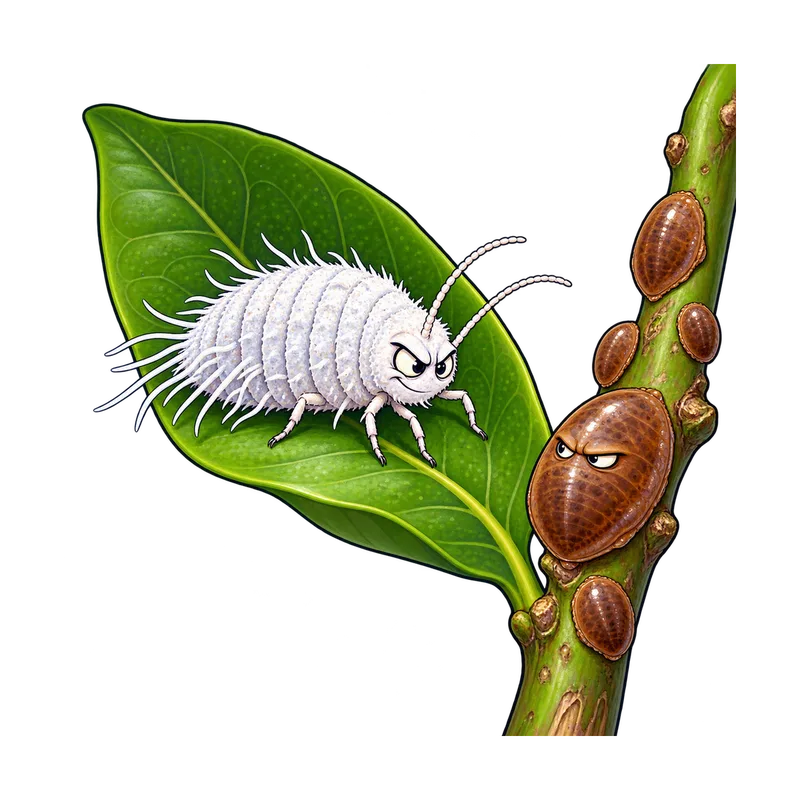
A mealybug infestation on stems looks like tiny patches of rolled-up cotton or dabs of white craft glue tucked into tight armpits where leaves meet branches. These raised, three dimensional waxy masses are made by soft-bodied, sap-sucking insects that also leave behind a clear, sticky liquid called honeydew.
What is actually going on
You are watering your favorite indoor fiddle-leaf fig or checking on the prized hibiscus out on the porch, and your fingers come away feeling strangely sticky. When you lean in closer to look at the main stem, you notice tiny patches of something that looks suspiciously like bits of rolled-up cotton or dabs of white craft glue tucked right into the tight armpits where the leaves meet the branch. If you have been wondering what a mealybug infestation actually looks like on stems, you are looking at it. Those fluffy white patches are not stray dust or mold. They are living, sap-sucking insects wrapped in protective waxy coats, throwing a quiet party at your plant's expense.
Mealybugs are soft-bodied relatives of aphids, and they treat plant stems like all-you-can-eat buffets. They wedge themselves into sheltered spots along the stem architecture, including node junctions, leaf axils, bark fissures, old pruning scars, and beneath protective leaf sheaths. Once they pick a spot, they sink their needle-like mouthparts deep into the plant's vascular tissue to feed on sugary sap. Because plant sap is low in nitrogen, they have to process massive amounts of it to get what they need, excreting the excess sugar as a clear, sticky liquid called honeydew. That syrup runs down the stems, pooling in petiole crotches and setting the stage for a secondary black fungus known as sooty mold to move in and paint the stems a velvety black.
To the naked eye or under a simple magnifying glass, adult females appear as small, oval, wingless organisms completely covered in white, powdery, or cottony wax. Depending on the specific variety, some stem-dwelling mealybugs can look downright deceptive. For instance, species that attack turfgrass stems and crowns often produce white waxy coats with purplish body patches showing through, making them look remarkably like little prills of slow-release lawn fertilizer sitting at the nodes. When the waxy accumulation is brushed away, you might find pale yellow to pink bodies underneath.
Beyond the visual mess of wax and mold, a heavy stem infestation takes a serious toll on the plant itself. Sucking the life out of the vascular tissue deprives the stem terminals of water and nutrients. You will usually spot early warning signs like leaf cupping, yellowing foliage near the infested nodes, and stunted growth. Left unmanaged, advanced infestations cause terminal wilt, dieback of entire branches, and a slow, depressing plant decline that makes you wonder why you bother keeping houseplants at all.
How to tell for sure
Figuring out what is wrong takes a closer look than a quick pass in passing light, so you need to look past a casual glance to confirm what you are dealing with. Pull out a ten times hand lens or a jeweler loupe and peer right into the stem node junctions and bark crevices. Mealybugs typically show up as raised, three dimensional waxy tufts or masses. That sets them apart right away from powdery mildew, which tends to form flat, dusty white circular spots rather than fluffy little bugs. They also differ from hard scale insects, which possess rigid, protective armor shells that do not rub off as a soft cottony mass.
Crawlers, which are the newly hatched nymphs, usually appear as tiny, pale yellow to amber specks without much wax on them, and they are usually mobile enough to walk along the stems. Mature females, on the other hand, stay mostly stationary and wrap themselves in that dense, thread like waxy egg sac that can hold up to six hundred eggs. If you touch the stem and feel a tacky, syrup like residue on your fingers before you even spot the insects, follow that stickiness upward. It will usually lead you straight to a hidden waxy colony tucked away from overhead watering and rain.
What usually comes next
Once you confirm the infestation, you generally have to make a choice between simple mechanical removal for light cases and more intensive treatments for widespread populations. If you only spot a few cottony clusters near a single stem node, you do not need to reach for heavy sprays. Instead, you can usually manage it by dipping a cotton tipped swab in seventy percent isopropyl alcohol and dabbing it directly onto the mealybugs. The alcohol dissolves their protective waxy coat and kills the insect on contact.
Always test a single leaf or stem section first, because excessive rubbing alcohol can sometimes cause foliar burn on sensitive plant varieties. For slightly larger outbreaks, a gentle wash with a mild insecticidal soap solution or a horticultural oil can help smother nymphs and crawlers, provided you use a forceful enough spray stream to penetrate those stubborn bark crevices and thick waxy secretions. Always read and follow the product label instructions carefully, and remember that rotating different treatment methods helps prevent pests from developing resistance over time.
When to get help
There are times when a bottle of rubbing alcohol and a cotton swab simply will not cut it, and you need to know when to call in backup. If you are dealing with widespread stem terminal dieback, extensive yellowing across an entire canopy, or thick black sooty mold encrusting the main structural stems of high value landscape trees or valuable greenhouse collections, it is usually time to consult a local extension office, a diagnostic laboratory, or a licensed professional applicator.
Commercial fruit growers, nursery operators, and anyone managing crops subject to strict agricultural biosecurity regulations should also seek professional guidance immediately, as certain mealybug species vector plant viruses and trigger quarantine rejections. Furthermore, if repeated biorational or chemical treatments fail to knock down the population, you may be facing pesticide resistance or a misdiagnosis that requires commercial high pressure equipment and expert oversight to resolve safely.