
Do all kissing bugs carry Chagas disease?
No, not all kissing bugs carry the single-celled parasite that causes Chagas disease. Field testing across different regions shows that infection rates vary wildly, usually depending on the specific species and the local animal population.
What is actually going on
You are sitting on your back porch on a warm June evening, watching the moths drift around the porch light, when a heavy, dark brown bug lands on the screen door with an audible thud. You grab a flashlight, look closer, and notice the distinct orange or red stripes along its edges. It looks suspiciously like the pictures of kissing bugs you have seen online. Panic sets in immediately. Does finding this insect mean you are about to contract Chagas disease?
The short answer is no. Not all kissing bugs carry the single-celled parasite that causes Chagas disease. While these blood-feeding insects can serve as vectors, field testing across different regions shows that infection rates vary wildly, usually depending on the species and the local animal population. Finding one of these visitors crawling near your patio light does not mean it is infected, and it certainly does not mean you have been exposed.
Even if you happen to catch an infected bug, it does not transmit the pathogen the way a mosquito or tick does. Mosquitoes inject parasites through their saliva when they bite, but kissing bugs do not work that way. The parasite lives entirely in the digestive tract of the bug and is shed in its waste. Transmission only happens if the bug defecates on your skin while feeding and you accidentally rub or scratch that waste into the bite wound, a cut, or your eyes.
Furthermore, different species have different habits regarding when they relieve themselves. Some tropical species defecate right on their host while feeding, which makes them highly efficient vectors. Many North American species, however, tend to crawl away and finish digestion elsewhere before dropping waste. That behavioral quirk is a major reason why locally acquired human cases remain exceptionally rare, even in areas where wild bugs frequently test positive.
How to tell for sure
You cannot tell if a kissing bug carries the parasite just by looking at it, and you certainly cannot tell from a bite mark on your skin. Dermatological reactions vary wildly from person to person. What looks like an angry, swollen welt to you might look like a mosquito bite to someone else, and no insect can be identified from a skin mark alone. If you want to know what you are dealing with, you usually need an intact physical specimen for an entomologist to examine under a microscope.
Kissing bugs belong to a group of insects known as cone-nose bugs, and they usually share some visual traits that help separate them from harmless lookalikes. Adults usually measure between half an inch and an inch and a quarter long, roughly the size of a coin. They have a distinct tapered head, elongated mouthparts tucked underneath for feeding, and a widened abdomen bordered by colorful stripes that are typically orange, red, or yellow.
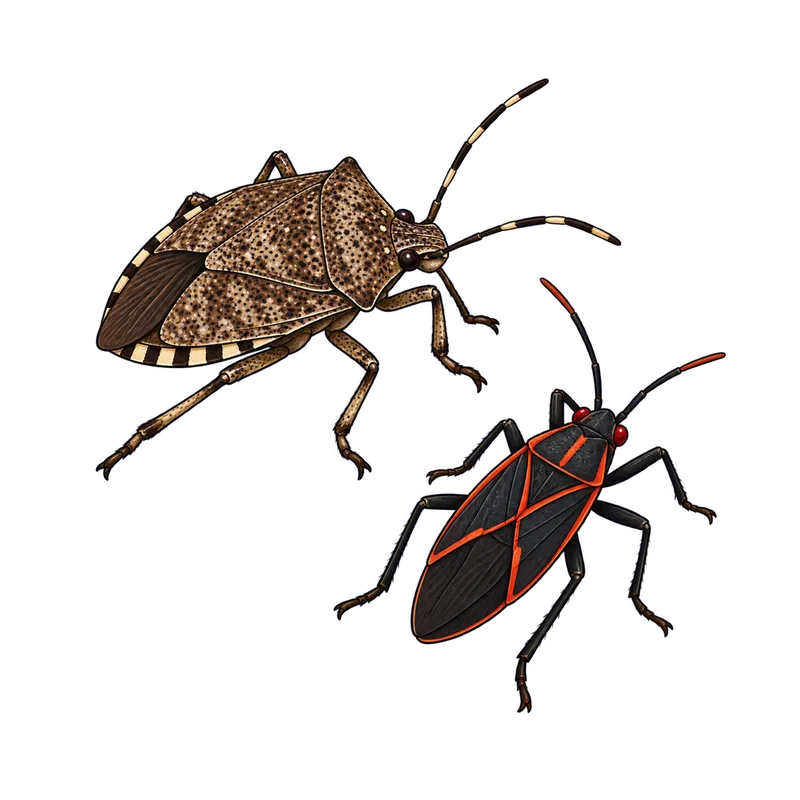
People frequently confuse them with leaf-footed bugs or predatory assassin bugs. The easiest way to tell them apart is by looking at their legs and body shape. Leaf-footed bugs usually have wide, leaf-like expansions on their hind legs, and plant-feeding bugs have broader bodies. Predatory assassin bugs often have shorter, thicker heads and lack the distinctive patterned margins of the true kissing bug. If you find a bug indoors, take a careful look at its structure before jumping to conclusions.
What usually comes next
When you spot one of these insects inside your house, your main practical choice is how to handle and get rid of it safely so you avoid its waste. Never grab a kissing bug with bare hands, and never smash it under a shoe or a paper towel. Crushing the bug squeezes out its insides and hindgut contents, which makes your risk jump if any of that material touches a scratch or gets near your eyes.
Instead, treat the insect like you would handle a piece of broken glass. Slip on a pair of disposable gloves, or turn a plastic storage bag inside out over your hand like a mitten. Gently guide the bug into the bag, seal it up, and drop it into the freezer for a couple of hours. Freezing kills the bug while keeping it whole in case you want to hand it over to your local health department or university extension office for proper identification and testing.
Once the bug is secured, take a moment to clean the spot where it was crawling. Mix up a standard solution of household bleach and water, and wipe down any hard surfaces or flooring the insect crossed. Wash your hands well with soap and water even if you used gloves, just to cover your bases. This steady, careful routine gets rid of the danger right away without causing new problems through panicked swatting.
When to get help
Most indoor run-ins involve a single adult bug that flew toward a porch light and slipped through an open screen door, which does not mean you need an exterminator. Still, if you think you have an infestation indoors, or if you keep finding multiple bugs inside or right around your living areas, you should call a licensed pest control professional to check structural entry points and outdoor hiding spots like woodpiles or animal nests.
Medical care depends entirely on how you feel. If you notice a mild, localized skin reaction after a suspected bite, wash the spot with soap and water and talk to a primary care clinician or visit an urgent care center for advice. Do not try to diagnose Chagas disease on your own. If you worry about exposure, a physician can run specialized blood tests.
There is one situation that calls for instant emergency help. Kissing bug bites can trigger severe allergic reactions in sensitive people. If you or someone in your house shows signs of a whole-body allergic reaction, such as widespread hives, swelling in the face or throat, wheezing, dizziness, or trouble breathing, call 911 or head to the nearest emergency room right away. If you already know you have a severe allergy to insect bites, talk to your doctor about carrying an emergency epinephrine auto-injector.