
What does a yellow-legged hornet nest look like?
A yellow-legged hornet nest changes appearance over the summer, starting as a grayish-brown paper globe the size of a tennis ball with a bottom entrance. By late summer, the mature secondary nest becomes a massive, egg-shaped structure ranging from a basketball to a beach ball in size, featuring a side entrance and a reddish-brown swirled paper texture.
What is actually going on
Picture stepping out onto your porch on a warm May morning, coffee mug in hand, only to notice a suspicious, grayish-brown paper globe dangling right under the eaves near the light fixture. It looks a bit like a crumpled-up paper bag about the size of a tennis ball. You might wonder if it is just an old wasps' nest from last year, or something you should worry about. If you happen to be dealing with the yellow-legged hornet, that little ball is actually just the starting point of an architectural progression that changes entirely over the course of a single summer.
These hornets do not build just one static home. Instead, a single colony moves house or expands through three distinct phases depending on the month. In early spring, a lone queen coming out of winter dormancy builds a small embryo nest about the size of a golf ball or a tennis ball in a sheltered spot, like a porch, shed, or low shrub, complete with an entrance hole right at the bottom. By early summer, as the first worker hornets hatch and take over the chores, that structure swells into a primary nest that looks roughly like a softball or a volleyball.
By the time late summer rolls around, the colony has exploded in population, sometimes housing thousands of workers. At this point, they typically abandon those low-slung spots and construct a massive secondary nest high up in the tree canopy, often thirty feet or more off the ground. This late-season structure is huge, usually ranging from the size of a basketball to a beach ball, and takes on an egg-shaped or pear-shaped form. Unlike the early nests, this mature aerial fortress features its entrance hole squarely on the side rather than the bottom, wrapped in a distinctive layered paper envelope that looks like a mix of wood pulp, mud, and reddish-brown paper.
How to tell for sure
People often assume all hanging paper nests look alike, but the yellow-legged hornet leaves specific visual clues that usually give it away. If you are looking at a native bald-faced hornet nest, the paper usually has a cool, cement-gray color. The yellow-legged hornet nest, by contrast, usually features a warm, reddish, muddy brown or tan swirled hue. The texture looks like layers of chewed wood pulp laid down in thin, concentric bands.
Size and placement usually tell the seasonal story. If you spot a small, tennis-ball-sized gray-brown ball tucked under a porch roof in April with a bottom entrance, that is usually an early embryo nest. If you are scanning the upper branches of an oak tree in September and spot a massive, beach-ball-sized teardrop swaying in the wind with a side entrance hole, you are usually looking at a mature secondary nest.
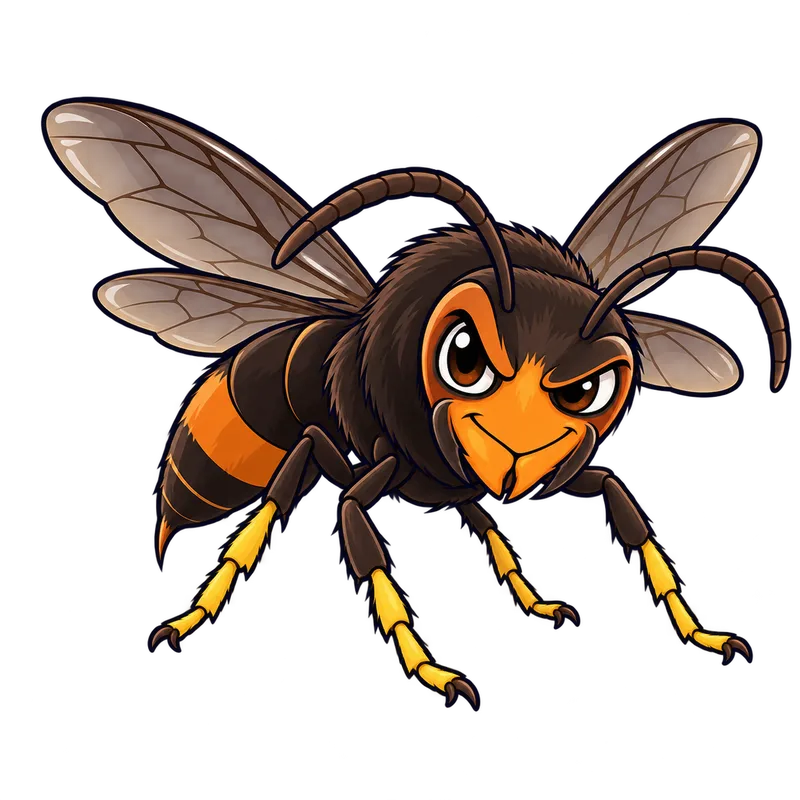
You can also look at the inhabitants if they are visible from a safe distance. These hornets have dark bodies, a solid dark thorax, and a distinct orange-yellow band on the fourth abdominal segment. Their most noticeable feature, which gives them their common name, is their bright yellow lower legs. Picture an insect wearing bright yellow athletic socks against a dark suit, and you have got the right mental image. You might also spot them hovering motionlessly in mid-air outside a beehive like a tiny helicopter, a predatory hunting habit known as hawking, where they wait to snatch returning honeybees right out of the air.
What usually comes next
When you spot a suspicious hanging paper nest near your home, your first instinct might be to grab a broom handle and knock it down before it gets any bigger. Resist that urge entirely. Because these hornets are fiercely defensive of their nest territory, getting close enough to swat at it can trigger a mass defensive attack involving dozens of stinging workers.
Instead of taking matters into your own hands, your best move is to document what you see from a safe distance of at least fifteen to twenty feet away. Grab your camera or smartphone, use the optical zoom to take clear photographs of the nest and any hornets hanging around it, and include a simple scale reference like a coin or pen if you happen to find a fallen fragment or a dead specimen nearby.
Once you have your photos safely secured, your next practical step is reporting the sighting through the proper official channels. Depending on your region, agricultural authorities and invasive species agencies track these sightings closely to map their spread and protect local ecosystems. In the United States, you can submit your photos and location details directly to your state department of agriculture or the online reporting portal managed by the United States Department of Agriculture. If you are in the United Kingdom or elsewhere, local environmental agencies and specialized monitoring apps provide direct reporting paths for suspected finds.
When to get help
There are moments when a pest issue crosses the line from a weekend task into a situation that requires immediate professional or official intervention. If you suspect you have found a yellow-legged hornet nest, you need to step away and involve the authorities right from the start. Homeowners should never attempt to spray, knock down, burn, or physically remove these nests. Trying to get rid of a mature nest on your own risks severe multi-sting injury, and an incomplete removal often just drives the surviving queen to scatter and start fresh somewhere else.
Beyond the physical danger of the nest itself, health and medical risks require caution. Hornet stings cause severe localized pain, intense swelling, and, for sensitive individuals, life-threatening allergic reactions known as anaphylaxis. If anyone gets stung multiple times, or shows signs of an allergic reaction such as difficulty breathing, dizziness, or swelling away from the sting site, seek emergency medical care immediately without waiting.
For the nest itself, once you report it to the relevant state agricultural department, the United States Department of Agriculture, or local biosecurity authorities, trained specialists equipped with appropriate protective gear and regulatory approval will handle the removal. Let the professionals manage the removal process, keeping yourself and your household safe from a defensive swarm.