
Where are seed ticks found?
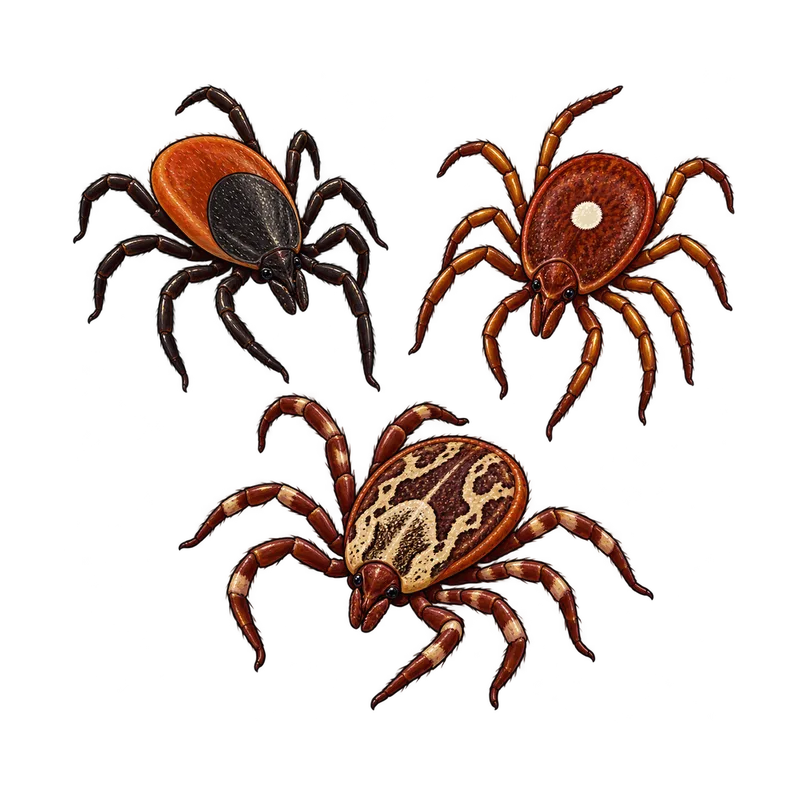
Seed ticks are found in moist and shaded microhabitats close to the ground, such as damp leaf litter, low-lying brush, and the tips of grass blades no higher than fifty millimeters. These tiny larvae stay low in sheltered ground cover to avoid drying out in the sun, waiting on vegetation for a passing host.
What is actually going on
Picture walking through the edge of a wooded yard on a warm afternoon, wearing shorts and sneakers. Later that evening, while sitting on the couch, you notice an itch around your ankles and look down to find what appears to be a dusting of freshly ground black pepper moving across your skin. Those tiny specks are seed ticks, and finding them usually means you brushed directly against a cluster resting in the low vegetation.
Seed ticks are primarily located in moist, shaded microhabitats close to the ground, specifically in damp leaf litter, low-lying brush, and on the tips of grass blades usually no higher than fifty millimeters. People often picture ticks dropping from tall tree branches like clumsy parachutes, but hard ticks do not work that way. Seed ticks are simply the six-legged larval stage of hard ticks. After a female tick feeds and drops to the ground, she lays a massive batch of eggs in one localized spot. When those eggs hatch, hundreds or even thousands of tiny larvae emerge together in what experts call a larval swarm.
Because they are so small, measuring around one millimeter, they dry out easily in direct sunlight. This forces them to stay low in sheltered ground cover where humidity is high. They climb up onto grass blades or leaf margins, stretch their front legs into the air, and wait for a passing animal or human. When you brush past that particular blade of grass, the whole cluster transfers onto you at once, which is why you suddenly find dozens of them crowded around your socks.
How to tell for sure
Telling what you are looking at usually requires more than a quick glance, and a smartphone photo is rarely enough to settle the question. A tiny brown bug viewed through a phone camera is like trying to identify a car from an airplane. Accurate identification usually demands a physical specimen examined under magnification to check tiny details like pronotal hairs or mouthpart ratios.
You also have to consider where the bites are located on your body. If you have hundreds of tiny red bumps strictly on your ankles and lower legs after walking through tall grass or brush, you are likely dealing with seed ticks or chiggers. If the bites are concentrated on your neck, shoulders, and upper chest after you spent the afternoon raking autumn leaves under a pin oak tree, you might be dealing with oak leaf itch mites instead. These microscopic mites drop from the tree canopy in huge numbers, acting like an invisible shower from above, whereas seed ticks always climb upward from the soil layer.
Another common confusion involves finding small, flat, reddish-brown bugs indoors. If they show up near ceilings or upper rooms, they are usually bat bugs rather than true bed bugs. Bat bugs hitch a ride from an attic bat roost, but they cannot reproduce on human blood alone. Telling them apart requires checking the length of the fringe hairs on the shield behind the head under a microscope.
What usually comes next
When you realize you just walked through a swarm of seed ticks, your main job is to get the ones that have not bitten yet off your skin before they dig in. Grabbing a simple lint roller or a strip of sturdy duct tape and pressing it against your skin or clothing can lift a whole crawling cluster right off you in seconds.
For the ones that have already anchored themselves and started feeding, you want to reach for a pair of fine-tipped tweezers. Pinch the tick as close to your skin as you can and pull straight up with steady pressure, avoiding any twisting or jerking. Skip old tricks like putting petroleum jelly or a hot match head on it, because startling the tick only makes it push fluid back into the bite.
If you plan on heading back out into the tall grass or brush, dress smart by tucking your pants into your socks so crawling pests cannot easily reach your bare skin. Putting a proper repellent on your skin and treating your outer clothes with permethrin spray can also stop them from climbing up your legs. Clearing away damp leaves and keeping your grass trimmed short around the edges of your yard takes away the dark, humid spots where these larvae love to hang out.
When to get help
Most tick encounters pass without turning into a major medical emergency, but certain symptoms mean you need to see a doctor right away. If you notice a growing red rash that spreads wider than four inches, especially if it starts clearing in the center, you should get it checked.
Keep an eye out for whole body signs showing up anywhere from one to thirty days after a bite, like a sudden fever, chills, a bad headache, a stiff neck, heavy fatigue, or swollen lymph nodes. Get emergency help immediately if you notice signs of a serious allergic reaction such as a swollen face, trouble breathing, or dizziness.
Growing muscle weakness, trouble keeping your balance, or a numbness that starts in your lower legs also requires urgent medical care. If you find weird bugs inside your house that might be bed bugs, bat bugs, or kissing bugs, pop a sample into a sealed container and take it to your local agricultural extension office or a licensed pest professional to figure out what they are before you start spraying chemicals.