
Are mole crickets dangerous?
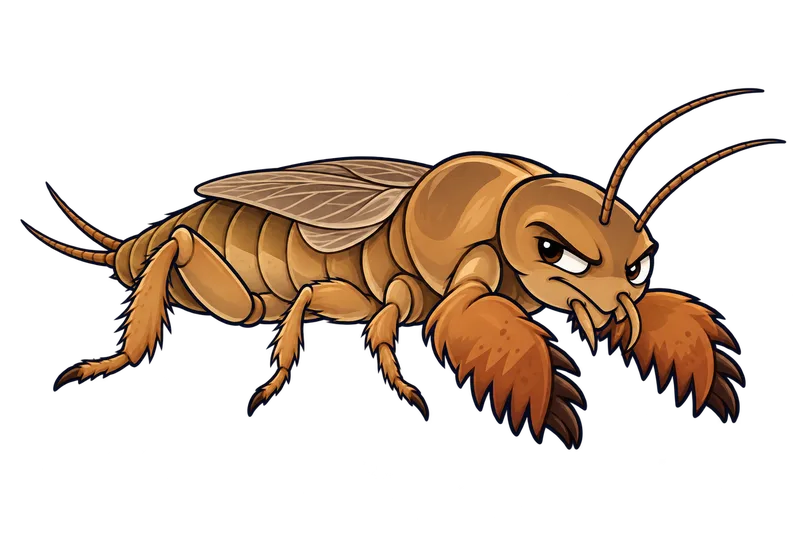
No, mole crickets are not dangerous to people or pets. These brown, cylindrical insects that grow to about an inch long have no stinger, carry no venom, and do not transmit disease. They can cause heavy damage to lawns, pastures, and gardens by tunneling through the soil and snapping grass roots.
What is actually going on
Picture this: you step out onto the lawn one August evening and the ground feels wrong. Springy, almost like walking across a foam mattress instead of solid turf. Then something that looks like a tiny brown lobster crawls across the driveway, and your brain jumps straight to the obvious question. Is that thing dangerous? Should the kids stop playing barefoot out there?
Here is the answer, plainly: no. Mole crickets are not dangerous to you, your kids, your dog or your cat. They do not bite in any meaningful sense, they have no stinger, they carry no venom, and they are not known to transmit any disease to people or pets. Pick one up and the worst it can do is shove against your fingers with those big shovel-shaped front legs, trying to dig its way out of your hand. It feels odd, maybe a little alarming the first time, but those legs cannot break your skin. The insect is built for moving dirt, not fighting mammals.
The catch, and it is a real one, is that mole crickets are genuinely destructive to lawns, pastures and garden beds. In the Southeast, from North Carolina down through Florida and across to Texas, invasive mole crickets cause hundreds of millions of dollars in turf and crop damage every year. They work like miniature bulldozers, tunneling through the top few inches of soil, snapping grass roots and leaving air pockets that dry the turf out from below. Some species also chew roots and seedlings directly. So the danger is not to your body. It is to your lawn, your vegetable patch and, if you keep livestock, your pasture.
One more thing worth saying, because people get this backwards: the biggest health risk in a mole cricket situation usually comes from the response, not the insect. Reaching for a broad-spectrum insecticide and applying it carelessly exposes your family and pets to chemicals far more hazardous than any cricket. The bug itself is the least scary part of this story.
How to tell for sure
Before you worry about anything, confirm what you are actually dealing with, because spongy turf gets blamed on mole crickets when the culprit is often something else entirely.
Mole cricket damage has a signature look. The ground feels soft and springy underfoot, and you will usually see raised, squiggly ridges of soil where the insects have tunneled just under the surface, like someone dragged a finger through wet sand in looping patterns. White grubs, by contrast, cut roots at the soil line, so dead turf peels back in loose sheets like a carpet, but grubs do not leave raised ridges. If your lawn lifts like a carpet with no ridges, think grubs. If it feels like a sponge with little soil tracks, think mole crickets.
The classic confirmation is the soap flush test, and it is genuinely simple. Mix about 1.5 tablespoons of liquid dish soap into a gallon of water, pick a spot with spongy soil or visible ridges, and pour the whole gallon evenly over a 2 foot by 2 foot square of moist turf. Then watch for three minutes. The soapy water irritates the insects' breathing pores and works like a gentle alarm clock, sending them scurrying to the surface where you can count them. Finding two or more in that square within three minutes generally means the population is high enough to justify doing something about it on a home lawn.
If you catch one, identification is easy in general terms. Adults are brownish, cylindrical, about an inch long, with a rounded shield behind the head and those unmistakable oversized front legs. If you want to know whether it is a pest species or a harmless native, look at the front feet under a magnifying glass. Native northern mole crickets have four claw-like projections on each foreleg and rarely cause lawn trouble worth treating. The invasive pest species have two. That one detail changes the whole answer, because treating for a native insect that is doing no harm is wasted effort and unnecessary chemical exposure.
A few caveats matter here. The soap flush only works on moist soil. During a dry spell, mole crickets retreat deep into the ground, sometimes well over a foot down, and no amount of soapy water will reach them. Water the area first, or wait until after a rain. And if you cannot confidently count the claws, or the damage pattern does not match either description, that is a reasonable point to stop guessing rather than treat on a hunch.
What usually comes next
So the soap flush came back positive and the count says it is time to act. Now comes the one decision that matters more than any product on the shelf: timing. And this is exactly where most people blow it.
The natural instinct is to go after the big adults you spot in spring, the ones clunking across the patio or orbiting the porch light at dusk. It feels satisfying, like you are taking the fight to the enemy. You are not. Those spring adults are heavily armored, they burrow deep, and they shrug off treatments that would flatten a younger insect. Worse, by the time they are out flying around, egg laying is already underway, so even a flawless kill does nothing about the generation about to hatch. Spraying spring adults mostly burns product and money while the real problem develops quietly underground.
The window that actually pays off is early to mid summer, roughly late June through July in the Deep South. By then the eggs have hatched and the young nymphs are small, soft-bodied and feeding near the soil surface, which makes them fragile and reachable. Treatments at that stage, whether conventional products applied exactly per label or biological options like beneficial nematodes, stand a far better chance of working. Exact dates shift by a couple of weeks depending on where you live, so a quick call to your county extension office will pin down the timing for your area.
While you wait for that window, a few low-effort habits take pressure off the lawn. Water deeply but infrequently instead of keeping the surface constantly damp, since mole crickets like moist topsoil for tunneling. Keep the mowing height right for your grass type rather than scalping it, because stressed, shallow-rooted turf shows damage faster. And during the spring flight season, switch off outdoor lights at dusk or swap to yellow bulbs, since the flying adults home in on bright lights. None of this wipes out an infestation on its own, but it tilts the odds in your favor.
Whatever product route you end up choosing, the label is the law and the instructions are there for a reason: application rates, watering-in requirements, and how long people and pets should stay off treated areas. If a product says to water it in with half an inch of irrigation, that step is not optional. It is how the treatment reaches the insects and how you keep residues where they belong.
When to get help
Most mole cricket situations are manageable at home with a soap flush, decent timing and a little patience. A few scenarios, though, call for backup.
Bring in a professional or your county extension agent if you cannot confidently identify what you have, if the damage covers a large area or keeps spreading despite treatment, or if you are considering a restricted-use product. Those formulations exist for licensed applicators, and the decision to use one belongs to them, not to a Saturday afternoon guess. If you run pasture with livestock, get agronomic advice before planting nectar plants like partridge pea to attract beneficial wasps, because that particular plant is toxic to grazing animals.
The genuinely urgent situations involve exposure, not insects. Mole crickets themselves will never send anyone to the doctor, but the chemicals used against them can. If someone shows signs of pesticide poisoning, such as sudden illness, trouble breathing or disorientation after an application, call 911. For guidance on a suspected exposure that is not an emergency, Poison Control is at 1-800-222-1222. If a pet eats granules, licks a treated surface or gets into bait, call your veterinarian or the ASPCA Animal Poison Control Center at 1-888-426-4435.
The short version: respect the lawn damage, ignore the horror-movie appearance, and treat the chemistry with more caution than the cricket.