
Do mole crickets bite?
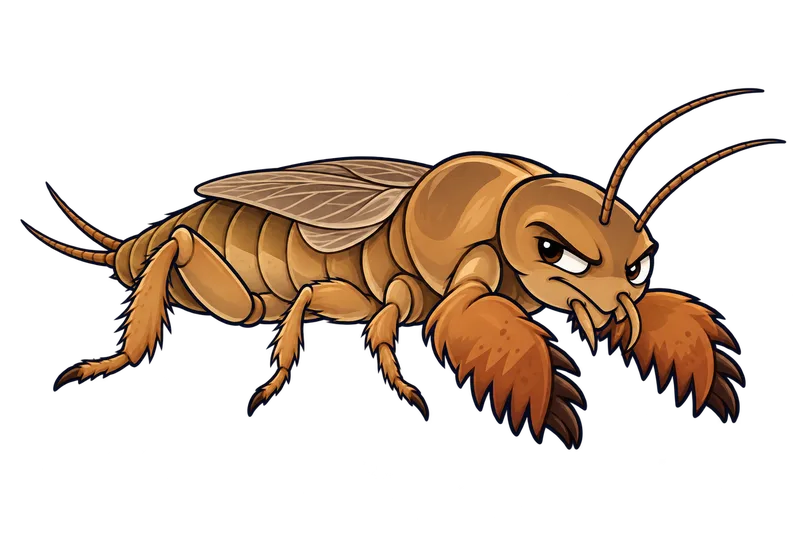
No, mole crickets do not bite people in any way that matters. They possess chewing mouthparts meant for clipping plant roots, but their jaws are small and cannot break human skin. If handled, they may push against your fingers with their oversized front legs or nip lightly, leaving only a faint pinch.
What is actually going on
Say you are out in the yard after a summer rain and something odd trundles across the patio: a fat brown insect that looks like somebody crossed a cricket with a garden trowel. You pick it up out of curiosity, it shoves hard against your fingers, and now you are standing there wondering whether it just bit you and whether that is a problem.
Short answer: no. Mole crickets do not bite people in any way that matters. They have chewing mouthparts built for clipping plant roots and, in some species, catching small soil insects. They have no stinger, no venom and no interest in your blood. They are not mosquitoes, ticks or fleas, which genuinely want something from you. A mole cricket wants to be left alone underground, and everything it does in your hand is an attempt to get back there.
So what did you feel? Usually two things. First, those oversized front legs. They end in broad, hard, finger-like blades that work like miniature shovels, powered by muscles strong enough to push through packed soil. Close your hand around the insect and it wedges those blades against your fingers and pushes. People call it a pinch or a scratch, and for an insect that size it is honestly surprising how forceful it feels. Second, it may nip at your skin with its jaws while trying to escape. Those jaws are small and made for snipping root fibers, so at worst you get a faint pinch. Under normal circumstances they cannot break human skin, and there is no toxin, allergen or disease being passed along either way.
One honest caveat: any time you handle a wild insect, wash your hands afterward, simply because soil insects carry soil. Beyond that, the creature is harmless to you. The real victim of a mole cricket is your lawn, and that is a different conversation.
How to tell for sure
If you still have the insect, identification is easy once you know what to look for. A mole cricket is usually light to dark brown, roughly an inch long, with a cylindrical body, short antennae and a hard shield-like plate behind the head. The giveaway is always the front legs: broad, flat and toothed, like the business end of a tiny excavator. No other common lawn insect looks quite like that. If your specimen has normal cricket legs and long, elegant antennae, you are holding an ordinary field cricket, which is even less interesting.
If your real question is whether mole crickets are in your lawn, the signs are different. Walk across the suspect area. Infested turf usually feels spongy and springy underfoot, almost like stepping on a thin foam pad, because the crickets hollow out tunnels in the top inch or two of soil. You may see raised, squiggly surface trails and patches of grass going brown even though you have been watering faithfully. That last part fools a lot of people. The tunneling severs the roots' contact with the soil, so the grass is cut off from its water supply no matter how much you irrigate. It looks exactly like drought stress, and watering harder accomplishes nothing except a bigger water bill.
To confirm, do the soap flush test, which is about as low-tech as diagnostics get. Mix 1.5 tablespoons of liquid dish soap into 1 gallon of water and pour it slowly over a 2 foot by 2 foot patch of moist, suspect turf. Then watch for 3 minutes. Mole crickets find soapy water irritating and crawl up out of their burrows, where you can count them and see whether they are adults or small nymphs. If 2 or more come up in that square within 3 minutes, you have a population worth acting on. The test also settles the usual mix-up with white grubs, which also brown out lawns. Grubs stay put under the sod and let you roll the dead turf back like a carpet. Mole crickets come up to say hello when the soap arrives.
One more distinction, mostly for curiosity. With a hand lens, the invasive pest species common in the Southeast have 2 prominent digging teeth on each front leg, while the native northern mole cricket has 4. The native one rarely reaches damaging numbers, so it is usually the two-toothed crowd tearing up the yard.
What usually comes next
Once you know what is in the yard, the real question is when to act. This is where plenty of people aim at the wrong target. The large mole crickets showing up in spring, buzzing around porch lights or crossing the driveway like tiny armored vehicles, are adults nearing the end of their run. Treating them can feel satisfying, but it usually does not accomplish much. They have already laid their eggs, they can stay deep in the soil, and they tolerate many treatments better than the younger insects do. The serious lawn damage comes afterward, when the eggs hatch and the nymphs feed through mid to late summer. At that stage they are smaller, nearer the surface and much easier to reach. Early to mid summer is generally the useful treatment window because the young crickets are shallow, vulnerable and present in numbers.
The soap flush tells you when those nymphs have appeared. After that, the decision is fairly straightforward. If only a few turn up, good turf care may be enough. Mow at the height recommended for your type of grass, water deeply but not constantly, and avoid keeping the surface damp all the time. During the spring flight season, switching off bright outdoor lights can also make your yard less attractive to females looking for a place to lay eggs. In parts of the Deep South, nature has already supplied some help: a parasitic wasp and a beneficial nematode are established there and go after pest mole crickets specifically.
If the count is high and the grass is going downhill, an insecticide may be justified. Here is the part not to improvise: read the product label and follow it exactly. The label is the law, and with mole crickets the small details decide whether the treatment works. Dry turf often has to be watered first so the insects move upward. Granular and liquid products generally need to be watered in afterward. Baits work the opposite way and must not be watered, since moisture can ruin the material the crickets are meant to eat. Reverse those steps and you may end up with a nicely irrigated lawn and the same mole crickets.
When to get help
You essentially never need medical help because of the insect itself. It cannot sting you, inject venom or deliver a bite that matters. There is one clear exception, and it is worth taking seriously. If you or someone in your household develops any kind of skin reaction, such as a spreading red area, swelling, pain or a lesion you cannot explain, do not ask anyone to identify the cause from a description or photograph. That includes me. A mark on skin cannot be reliably matched to a particular insect that way. Have a doctor, an urgent care clinic or your regional poison control center look at what is actually happening.
For the lawn, bring in a licensed turf professional if the infestation covers a large area, if treatment has already failed and the soap flush still brings up crickets, or if damaged turf would be especially costly. Athletic fields, golf greens and pastures where cattle can pull up loosened grass by the roots fall into that category. Some of the more effective products are restricted-use materials, which means only licensed applicators can apply them. If you handle treatment yourself, keep the product off pavement and other hard surfaces where runoff can travel toward storm drains. Do not spray flowering plants while bees are visiting them, either.
The mole cricket in your hand is built for digging, not biting. Put it back down, test the suspicious turf with soapy water and save your concern for the grass.