
Do thrips bite people?
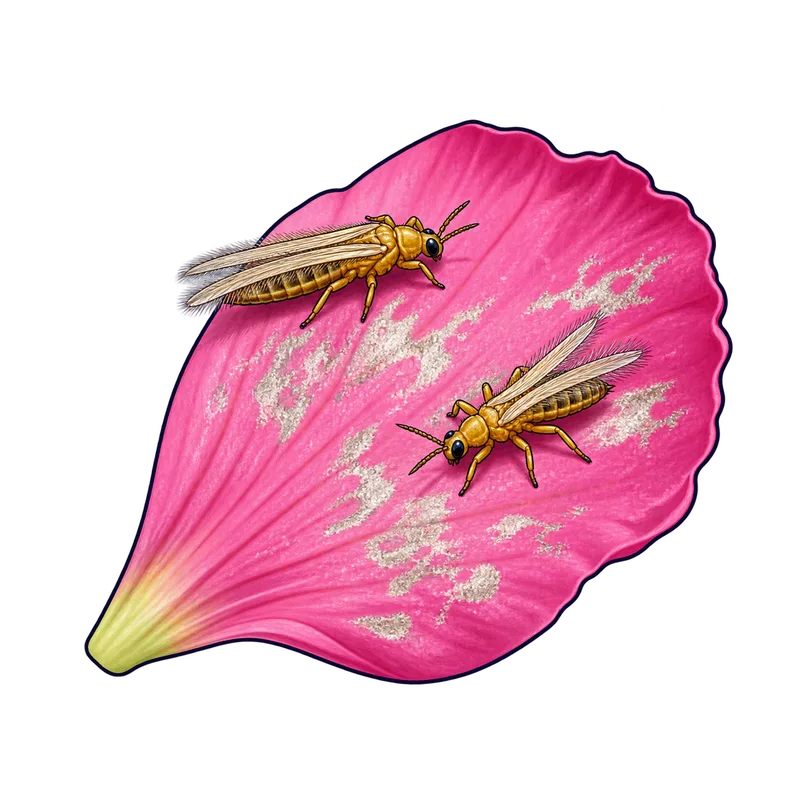
No, adult thrips do not bite people in any way that matters. These tiny plant feeders, usually around one millimeter long, feed only on leaf and flower tissue and cannot live on humans. When they land on skin during warm weather, they may give a brief exploratory probe that feels like a pinprick, but they do not feed on blood or pass disease.
What is actually going on
Picture a muggy July afternoon. You are out in the garden deadheading the roses, wearing a bright yellow t-shirt because it was clean, and suddenly your forearm feels like something is walking on it. You look down and there is a tiny dark speck, about the size of the period at the end of this sentence, moving across your skin. Then a faint prickle, almost like a pinprick, and the speck is gone. Later you tell someone a bug bit you in the garden, and now you are wondering whether thrips bite people.
Here is the straight answer: no, thrips do not bite people in any way that matters. They do not feed on blood, they cannot live on you, and they have no interest in you as a meal. Thrips are plant feeders. Their mouthparts are built to rasp at leaf and flower tissue and suck out the sap, a bit like scraping the top off a soft fruit and drinking what is underneath. Some species skip plants entirely and hunt even tinier prey, like spider mites. Human blood is simply not on the menu, and their anatomy could not process it if it were.
So what was that prickle on your arm? When thrips swarm in warm, humid weather, the winged adults take to the air and drift on light breezes, landing pretty much anywhere, including on you. Once one lands on skin, it may crawl around or give a brief exploratory probe with those rasping mouthparts, testing whether you have turned out to be a leaf. You have not, so it stops. The result can be a momentary prickling sensation or a small red speck that fades quickly. Think of it as someone taking a tentative nibble of a plastic display apple and immediately realizing their mistake. It feels like a bite, but it is not one. There is no venom, no blood meal, and no disease passed to you.
One more thing worth knowing: the wingless young thrips, called nymphs, get around partly by hitchhiking on clothing, skin, tools and pets. So if you have been working among infested plants, you can carry a few passengers without noticing. A quick brush-off or a shower after gardening takes care of it, and that is genuinely all the drama involved.
How to tell for sure
The first clue is size. Thrips are genuinely tiny, usually somewhere around 1 mm long, with some reaching close to 3 mm. On your arm they look like a moving fleck of dust or a sliver of dark thread. Color varies a lot by species: yellow, pale green, orange, light brown, nearly black. If what landed on you was clearly visible at arm's length, with wings you could actually make out, it probably was not a thrips.
The second clue is context. Thrips encounters usually happen outdoors in warm weather, near flowers, vegetables or other greenery, and often in still, muggy conditions when the adults are flying in numbers. In Britain and Ireland they are so tied to thundery summer days that people call them thunderbugs. If the specks on your shirt appeared while you were shaking out a flower cluster or brushing past tall grass, thrips are a reasonable guess. If you are getting itchy welts indoors at night, that is a completely different conversation, and thrips are not the suspect.
If you want to actually see one, a 10x hand lens held over a flower or leaf will usually reveal them: slender little insects, the adults with narrow fringed wings folded flat along the back, the nymphs wingless and paler. On plants, their feeding leaves a recognizable signature too: silvery or bronze stippling on leaves, distorted new growth, and tiny dark specks of droppings. That plant damage is often the most reliable evidence you are dealing with thrips at all, more reliable than anything that happened on your skin.
Now the honest limit. Telling one thrips species from another is not something you can do with your eyes, a magnifier or a phone photo. That takes a specialist with a microscope. And here is the part people push back on: no, a mark on your skin cannot tell you what made it. Bite marks and rashes from different insects look frustratingly similar, and plenty of skin reactions have nothing to do with insects at all. If you are getting repeated bites, the way to identify the culprit is to find and collect an actual specimen, not to match your skin against pictures online and declare a verdict.
What usually comes next
For most people the practical answer is wonderfully boring: nothing needs to happen to you. If thrips land on you while you are out in the garden, brush them off, or hop in the shower when you come inside. That is the entire personal protection plan, start to finish. One thing I will be blunt about, because it comes up more often than you would expect: never spray garden or crop pesticides on your skin or your clothes to keep insects away. Those products are not repellents, the label is the law, and skin contact is the most common route to pesticide poisoning. If you genuinely need protection from real biters like mosquitoes, buy a product that is actually labeled for use on skin.
The question that actually matters is usually whether your plants need help, because plants are where thrips do their real damage. Before you treat anything, confirm the pest is actually there with a hand lens. Plenty of beneficial insects get blamed for thrips damage and end up sprayed for a crime they did not commit, which helps nobody, least of all your garden. If you do confirm an active infestation, the gentler options often work well: a strong jet of water to knock them off, insecticidal soap or neem-based products for direct treatment, or spinosad when the pressure is heavier. Whatever you use on edibles, read the label and respect the pre-harvest interval, the required wait between spraying and picking. Soap and neem products generally allow harvest once the spray has dried, while spinosad usually means waiting a day or a few days depending on the crop. The label on your specific product is the final word here, not anything you read in this post or anywhere else.
Two cautions that will save you real heartache. Pyrethrin and pyrethroid products are highly toxic to cats and to fish, so keep them well away from pets and ponds. And spinosad harms bees while the spray is still wet, so apply it early in the morning or late in the evening, when pollinators are not out working the flowers. A little attention to timing prevents a lot of collateral damage.
When to get help
If your skin reaction goes beyond a fleeting prickle, meaning spreading redness, blistering, swelling or anything else that worries you, skip the internet diagnosis and see a clinician. Skin marks cannot be matched to a culprit by appearance, no matter how many comparison photos you scroll through, and a doctor can actually assess what is happening instead of guessing. The same goes for any suspected pesticide exposure: in the United States, call Poison Control at 1-800-222-1222, and for severe symptoms like trouble breathing or loss of consciousness, call 911.
On the plant side, if you are finding thrips you cannot identify on valuable crops, or something that looks unusual for your area, your local extension service is the right first call, and they can arrange a proper identification. Suspected exotic or quarantine pests should be reported to your state department of agriculture or the relevant plant health authority where you live.
And if the bites are happening indoors, at night, in clusters on your ankles or in lines along your skin, stop thinking about thrips entirely. That pattern points to fleas, bed bugs or mosquitoes, and identifying the real pest, sometimes with a professional's help, is what actually solves the problem. The tiny hitchhiker from the rose bush is off the hook.