
What are thrips on plants?
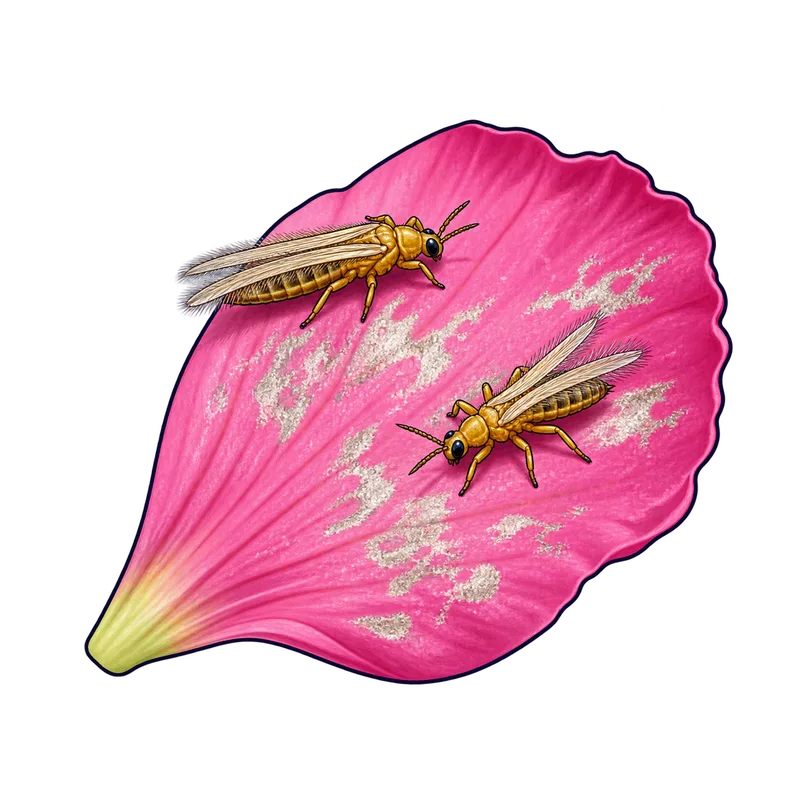
Thrips on plants are minute, slender insects measuring between 1/25 of an inch and a little over a tenth of an inch long. They use piercing mouthparts to drink plant sap, which turns the foliage into a metallic silver color and leaves behind tiny black specks of waste.
What is actually going on
You are standing by the kitchen window, watering your favorite monstera or fiddle-leaf fig, when you notice something odd on the foliage. The leaves do not look chewed or bitten through like a caterpillar has been at work. Instead, patches of the green surface have gone dull, taking on a metallic silver cast, as if someone rubbed them lightly with steel wool. When you turn a leaf over, you spot a scattering of tiny black specks that look remarkably like grains of coarse ground black pepper. You tilt the leaf closer to the light, and suddenly one of those specks starts moving, gliding across the green with a jerky, sliding motion.
What you are looking at is an infestation of thrips. Thrips are minute, slender insects, usually measuring between 1/25 of an inch and a little over a tenth of an inch long. They are so small that an adult often looks like a tiny sliver of sewing thread or a dot drawn by a ballpoint pen. If you manage to look at one under a magnifying glass, you will see they possess strange, feather-like fringed wings that lie flat along their backs, resembling miniature eyelashes attached to a hair-thin body.
Unlike beetles or caterpillars that chew away whole chunks of leaf margin, thrips are equipped with piercing and sucking mouthparts. They operate much like a tiny pair of miniature garden tools that punch open the outer layer of plant cells so the insect can drink the sap inside. Once the cell contents are sucked out, air fills the empty spaces. That vacuum of empty cells is what turns the foliage into that bleached, silver, or bronzed color.
As populations multiply, the damage spreads from the older leaves to the soft growing tips and unopened buds. You might notice new leaves unfurling with a crinkled, stunted, or severely distorted shape. Flowers drop prematurely, and vegetables or ornamentals lose their vigor. Worse still, these insects do not just feed on plants; they act as living carriers for severe plant viruses, transferring pathogens from leaf to leaf as they move and feed.
Spotting thrips requires looking past the general decline of the plant and searching for specific physical evidence. You will usually find the insects themselves clustered on the undersides of leaves, along the main veins, or tucked tightly inside developing flower buds. Nymphs, which are the immature stages, are typically wingless and paler yellow or amber, while adults can range from pale yellow to dark brown or black depending on the specific type.
Do not rely on finding holes in the leaves, because you usually will not see any. The definitive visual cue for thrips is a combination of two things occurring together: silvery or bleached patches on the foliage, and tiny, hard, black droplets of liquid fecal waste scattered across those same damaged areas. Those black dots look just like dried flea dirt or spilled pepper.
How to tell for sure
You can run a quick, reliable check by holding a sheet of plain white printer paper underneath a suspicious branch or flower cluster. Tap the plant stem gently against the paper. If thrips are present, you will see tiny, thread-like yellow or brown specks tumble onto the white surface and immediately begin crawling around.
It is easy to confuse thrips damage with the work of spider mites, but there is a major difference. Spider mites spin fine, silky webs across the undersides of leaves and between stems. Thrips do not produce any webbing at all. If the leaves are silver and peppered with black dots but completely free of webs, you are almost certainly dealing with thrips rather than mites.
What usually comes next
Once you confirm you have thrips, your immediate instinct will likely be to grab a bottle of insect spray from the garden center and douse the plant. Stop right there, because making that exact move is why most gardeners fail to beat this pest. The single most important practical decision you face is accepting that a single spray treatment will never solve the problem.
Think about how thrips reproduce. Female thrips use a saw-like body part to cut open plant tissue and lay their microscopic eggs safely inside the leaves or buds. Furthermore, the late-stage nymphs drop off the plant down into the soil or growing media to pupate before emerging as new winged adults. Sprays only reach the active pests walking around on the foliage. The eggs hidden inside the leaf tissue and the pupae resting in the soil are entirely shielded from contact treatments.
If you spray once and walk away, the eggs hatch a few days later, the pupae emerge from the dirt, and you are right back where you started with a fresh wave of insects. Managing an infestation successfully means committing to a multi-stage approach. You need to treat the plant repeatedly over a span of several weeks to catch each new generation as it emerges, while also cleaning up debris and checking the soil where the pupae hide.
When to get help
Most indoor houseplant or backyard garden thrips problems can be managed with patience and persistence, but certain situations cross the line into territory that requires outside help. If you operate a commercial greenhouse, a nursery, or a large-scale indoor crop production facility and notice an explosive population surge that overwhelms your routine controls, you should bring in a licensed pest control operator or a professional crop consultant. In enclosed commercial settings, thrips multiply exponentially, and managing them requires a carefully rotated resistance-management program using professional-grade applications.
There are also statutory biosecurity situations to take seriously. If you suspect your plants harbor a regulated, high-risk quarantine species such as the melon thrips or chilli thrips, you are legally obligated to stop moving any plant material from the area and immediately notify your local state or national agriculture department, such as the United States Department of Agriculture Animal and Plant Health Inspection Service, the Canadian Food Inspection Agency, or the relevant plant health authority in your region.
Finally, keep safety in mind regarding treatment chemicals. If you are handling potent conventional insecticides or restricted-use products on large properties, always defer to licensed applicators who possess the proper protective gear and application equipment. Never use a pesticide in a way that contradicts the instructions printed on the product label.