
Why are thrips in the house?
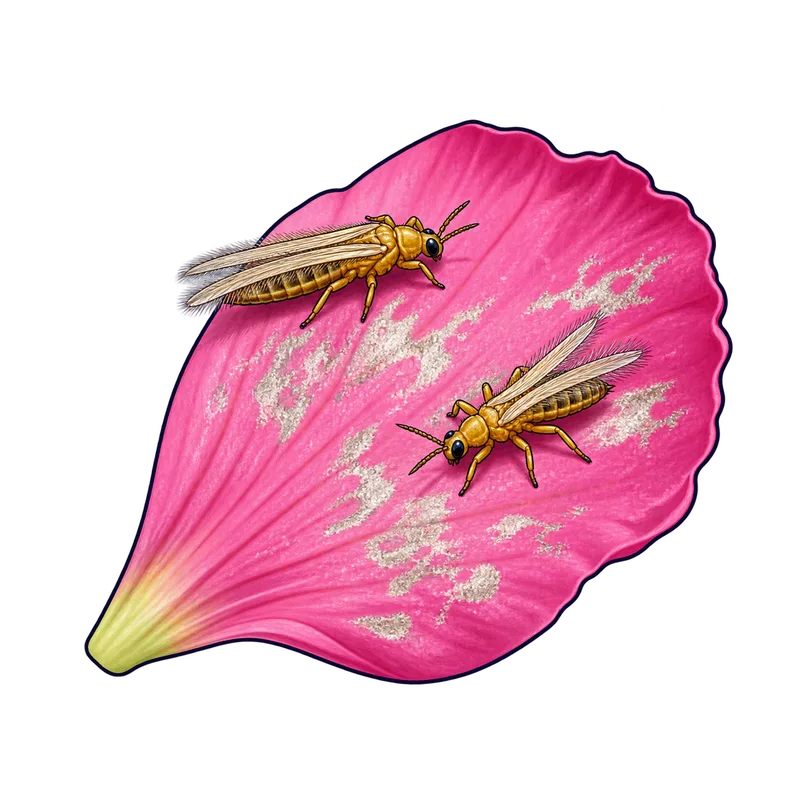
Thrips get into the house by hitchhiking on the foliage or soil of a brand new houseplant or by drifting through window screens on a warm summer wind. These millimeter-long insects enter homes in search of moisture and fresh plant juices, often attracted by the comfortable year-round indoor temperatures and tender houseplants.
What is actually going on
You are watering the fiddle-leaf fig in the corner, feeling smug because you managed to keep a difficult plant alive for six months, when you notice something strange. The leaves look oddly dull, almost silvery in patches, and when you lean in closer, you see what looks like tiny grains of black pepper scattered across the undersides. Then one of the pepper specks moves. You did not leave the doors open for days, you do not live next to a farm, and yet you have an audience of slender, millimeter-long insects crawling over your indoor jungle. How on earth did they get in there?
The short answer is that thrips are masters of the hitchhiking arts, or they simply drifted in through the mesh of your window screen because their bodies are narrow enough to treat standard household screening like a wide-open gate. They usually arrive in the house by two main routes. Either they rode in quietly inside the soil or on the foliage of a brand-new houseplant you bought at the garden center last weekend, or they caught a warm summer wind from outdoor weeds and flowerbeds, wandering indoors through a cracked window in search of moisture and fresh plant juices.
Once they get inside, your living room acts like a permanent, climate-controlled paradise. Outdoors, they have to deal with predators, driving rain, and freezing winter temperatures that send them scrambling into plant debris to wait out the frost. Inside your house, there is none of that. The ambient temperature stays comfortable year-round, and your houseplants provide a continuous buffet of tender leaves. A single female thrips can slip past your notice, insert her eggs directly into the plant tissue, and kick-start a thriving indoor population without ever needing to step foot outside again.
How to tell for sure
Before you start tearing your plant collection apart, you need to confirm what you are looking at, because not every tiny bug on a leaf is a thrips. Adult thrips usually measure about one-twenty-fifth of an inch long, which makes them roughly the size of a sharpened pencil tip. They are remarkably slender, often colored pale yellow, brown, or black, and they possess tiny fringe-margined wings that look more like delicate feathers than the solid wings of a beetle or a fly. If you try to catch one, you will usually find they are surprisingly quick, either darting away or taking a short, awkward hop.
The damage they leave behind is normally your best diagnostic clue. Thrips have specialized mouthparts that punch into plant cells and drain out the liquid contents, which is what creates those distinctive silvery patches or bleached streaks on the upper surfaces of the leaves. As they feed, they leave behind tiny drops of liquid excrement that dry into hard, pitch-black specks. If you see silvery stippling paired with what looks like microscopic black pepper specs clustered on the leaf undersides, you usually have thrips rather than spider mites, which tend to spin fine silk webbing, or powdery mildew, which looks like flour dusted on the foliage.
You can usually verify the diagnosis by grabbing a cheap hand magnifying glass and taking a close look at the plant veins. Nymphs, which are the immature stages of the insect, look like pale, wingless versions of the adults, crawling sluggishly across the damage zone. If you still cannot spot them with the naked eye, place a bright yellow sticky card right near the plant canopy. Thrips are strongly attracted to the color yellow, and within a day or two, wandering adults will usually fly over and get trapped on the card, giving you a definitive answer.
What usually comes next
When you finally realize you are dealing with thrips, you arrive at a crossroads: do you roll up your sleeves and fight the infestation with a mix of physical cleaning and targeted treatments, or do you simply wave the white flag and throw the ruined plant in the trash? Your decision usually comes down to how much you care about the green thing in question and whether the bugs have already staged a hostile takeover of your other plants. If you spot the damage early on a single, isolated pothos sitting by itself on the kitchen counter, your smartest move is to quarantine that plant instantly, dragging it as far away from your main indoor jungle as possible before the insects start spreading.
Quarantine works well because thrips are surprisingly sluggish flyers inside a closed home, preferring to crawl across overlapping leaves or make short, clumsy hops to the nearest pot. Banishing the sick plant to a bathroom or a spare room puts a physical barrier between them and your healthy greenery. Once the plant is isolated, you can take a hard look at its condition and decide whether it is strong enough to handle a strict routine of washing the foliage and applying treatments, or if it is already too far gone to justify weeks of tedious nursing.
When to get help
Most household thrips battles can be won on your own with a bit of domestic persistence, but there are times when you should put down the spray bottle and call in an expert. If you run a commercial nursery, manage a large greenhouse, or suspect you have stumbled upon a regulated agricultural threat like the melon thrips on an imported tropical plant, handling the situation yourself is the wrong move. Local agricultural laws often require that suspected quarantine pests be reported directly to state departments of agriculture or federal plant health authorities so they can stop the bugs from escaping into local farm fields and orchards.
As far as your own skin is concerned, thrips do not bite to feed on human blood, and they do not carry human diseases, though an occasional wanderer near a sunny windowsill might mistake your arm for a plant and give you a harmless, fleeting pinch. If you do run into unusual skin irritation, a strange allergic response, or any kind of accidental chemical exposure while treating your pots, get in touch with a doctor, an urgent care clinic, or your local poison control center. If you are facing a massive infestation inside a large sunroom or a tricky commercial setting that demands heavy equipment, leave the tough choices and restricted applications to a licensed pest control professional.