
What do adult thrips look like?
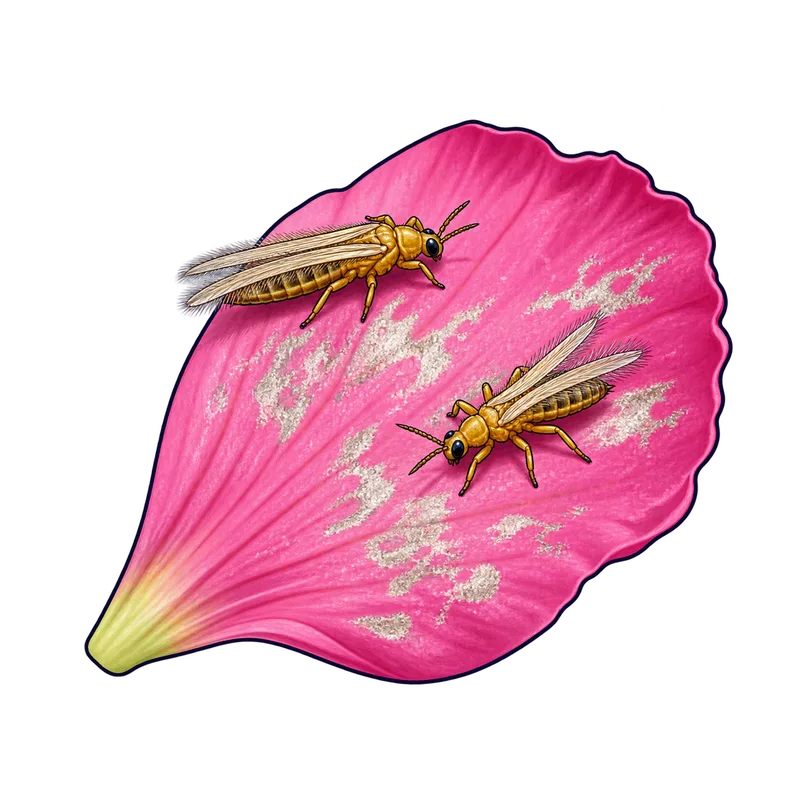
An adult thrips is a very small insect about 1/25 inch long, shaped like a narrow sliver with a pointed abdomen. They carry two pairs of narrow wings edged with fine hairs that fold flat over the back. Colors range from bright yellow to tan, dark brown, or black.
What is actually going on
You are watering a pepper plant or cutting a rose for the kitchen counter, and a fleck that looked like ground pepper suddenly walks. That is the moment most people meet an adult thrips. It is not a baby beetle, not a gnat, and not a speck of dirt with ambition. It is a very small insect, usually around 1/25 inch long, about 1 mm, shaped like a narrow sliver. Some are bright yellow or pale green, some are tan, and plenty are dark brown or black. Color is a weak clue because it shifts by species and even by age. Shape is the better bet: slim body, pointed little abdomen, and a quick sideways dart when you disturb it.
The real giveaway, if you can get close enough, is the wings. Adult thrips carry two pairs of very narrow wings edged with fine hairs, like tiny paddles trimmed with feather fibers. Folded flat over the back, those wings can make a darker line down the middle of the body. The scientific name for the group even points at this: Thysanoptera means fringe wings. They are not strong fliers. They flutter, hop, and drift on air more than they steer, which is why one light shake of a flower can turn a calm leaf into a small evacuation.
One grammar trap worth clearing up, because it trips everyone: the word is thrips for one and for many. You can find a thrips, and then thirty thrips, but there is no such thing as a thrip outside of typos. The young ones are easier to miss. Nymphs are smaller, usually paler, often cream or yellow, and they have no developed wings. Adults are the stage that moves freely between plants, which is exactly why noticing adults matters.
The reason people usually start asking what thrips look like is not the insect itself. It is the damage that shows up first: silvery or bleached patches on leaves, buds that open crooked, leaf edges that cup or pucker, and tiny black dots that look like tar grains. Thrips rasp the surface and suck out the contents of plant cells, so the emptied cells turn pale and the black specks are their droppings. They are plant feeders. They do not hunt people, they do not suck blood, and they do not spread human disease, though a heavy summer flight can leave a harmless tickle or brief skin irritation when one lands on you.
How to tell for sure
Start with scale, because scale solves half the mystery. An adult thrips is about the width of a coarse eyelash or a single fleck of finely ground pepper. If the thing on the leaf is clearly round, oval, or has obvious legs sticking out like a tiny tank, think again. If it looks like a moving thread, a miniature splinter, or a yellow dash that suddenly stops pretending to be debris, thrips belongs on the suspect list.
Use your eyes first, then a lens. A 10x to 30x hand lens or jeweler's loupe is usually enough to confirm the narrow body and the fringed wings. You do not need to name the species in your kitchen, and honestly you usually cannot. Species level identification often needs a lab microscope at 60x or more, sometimes even molecular testing, because some thrips are nearly identical twins with different paperwork. For home decisions, the goal is simpler: is this a thrips, is it alive, and is it feeding?
The white paper test is the friendliest trick in the whole business. Hold white printer paper or a white paper plate under a flower cluster, branch tip, or suspicious leaf, then tap the plant firmly two or three times. Hidden thrips drop onto the white surface and show up as moving dashes. Do this over a rose bloom and you may feel briefly betrayed by the rose. That is normal. The paper test beats staring into a leaf until your eyes file a complaint.
Check the places thrips prefer: leaf undersides, along veins, inside curled new growth, and deep in flower petals. Look for the combination, not one clue alone. A silvery patch plus black specks plus a slender moving insect is much stronger than color by itself. Fresh damage matters too. Old scars stay after the insects have left, so treat scars as history unless you can find current residents.
A few lookalikes need a firm but polite separation, because half the wrong treatments start with the wrong suspect. Powdery mildew leaves a dusty white coating you can often rub off with a finger, while thrips injury is scarring with black droppings. Spider mites are rounder and spin fine webbing, and thrips make no silk at all. Aphids are softer and pear shaped, with little tailpipe structures sticking out at the rear. Leafhopper nymphs can be small and pale, but they scuttle sideways like tiny crabs. Whiteflies lift off in a pale cloud when you disturb them. Thrips tend to dart, hop, or flutter weakly rather than rise in a snowy crowd.
Color gets one more warning, because everyone loves a shortcut and this one lies. Yellow does not prove thrips, and dark brown does not rule them out. Some adults are nearly all yellow, some are amber, some are black with a paler band, and some only look dark because their folded wings draw a stripe down the back. If the identification changes what you are legally or commercially allowed to do, especially with imported plants or nursery stock, a phone photo and confidence are not enough.
What usually comes next
The practical question is not "what spray kills everything." It is whether you have live thrips and fresh damage on a plant you actually care about. If the paper test comes up empty and the silvery marks are old, you may be standing over last month's crime scene. Outdoor plants can often carry a few thrips without turning into a disaster, especially if predators are around and the new growth looks clean. A strong rinse with water, removing badly distorted buds or flowers, and isolating a suspicious houseplant is a sensible first move, not a defeat.
If live thrips keep showing up and new leaves keep coming out scarred, act while the population is small. Pick a product labeled for thrips and for that exact plant or crop, then follow the label as written: where to spray, how often, protective clothing, and the pre harvest interval for edibles. Coverage matters because thrips hide on leaf undersides and inside buds, and a contact product does nothing to the insect it never touches. On edible plants, the harvest wait is part of the decision, not fine print to skip.
Gardeners usually ask about the gentler options first, things like insecticidal soap, neem products, pyrethrins, and spinosad, and each one comes with conditions. Soap needs direct contact and leaves no lasting residue. Spinosad can work well on thrips but is dangerous to bees while the spray is wet, so timing it away from pollinator activity matters. Pyrethrins knock insects down fast but can also hit beneficial insects, and broad spectrum pyrethroids are a poor habit where spider mites are present, because they remove the predators that keep mites quiet. That is how a thrips problem becomes a mite problem with better marketing.
Keep the goal modest: protect new growth, not sterilize the garden. Recheck with the paper test after several days and again once new leaves expand. If damage keeps appearing despite good coverage and proper label use, then resistance, reinvasion from nearby plants, or a misidentified pest may be involved. That is the point where more product is usually not the clever answer.
When to get help
Call in professional help when the plants are valuable, the setting is a greenhouse or nursery, the problem keeps returning, or the crop is close to harvest and the label choices feel like a legal exam. A licensed applicator or your local extension service can separate thrips from mites, disease, and lookalike insects, and can tell you which products are registered and sensible for your situation.
If you suspect a regulated quarantine species, especially on imported ornamentals, commercial stock, or plants you might move or sell, contact the responsible plant health authority before relocating anything. This matters most for businesses and for readers outside the United States, but the safe rule travels well: do not distribute suspect plant material while you wait for an answer.
On health, keep perspective without brushing off real reactions. Thrips do not feed on people, but any insect landing on skin can be annoying, and pesticide exposure is a different story. If someone has trouble breathing, swelling, a spreading rash, eye exposure, or symptoms after mixing or spraying a product, contact poison control or a clinician promptly and bring the product label with you. For ordinary garden thrips, though, the patient is the plant, and the best medicine is a correct identification before anyone reaches for a sprayer.