
How do you identify thrips on a Monstera?
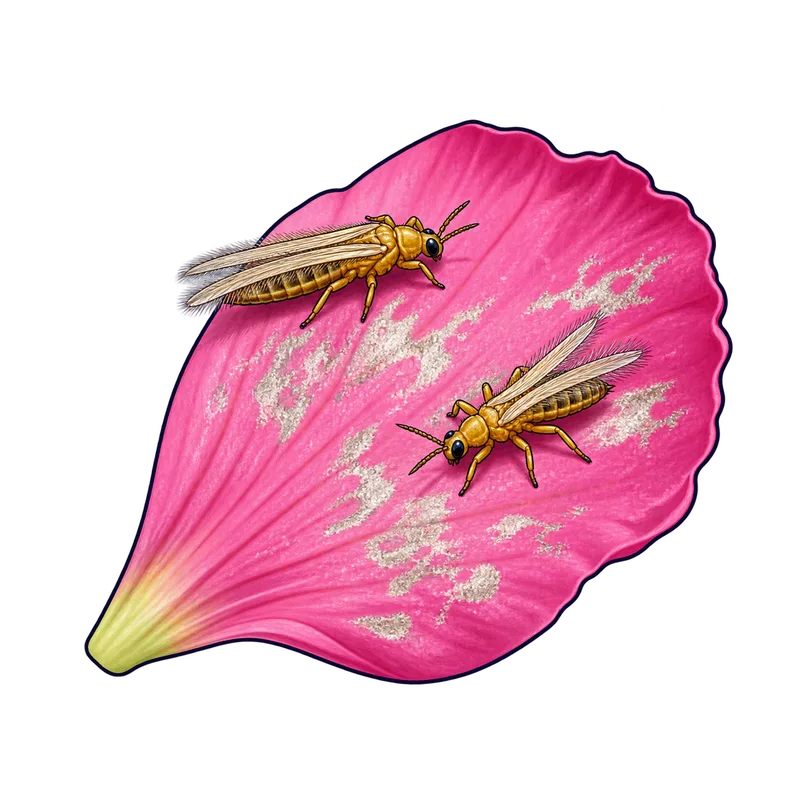
Identify thrips on a Monstera by looking for slender insects about 1/25 inch long paired with silvery leaf patches and small black specks of dried droppings. Young nymphs are pale yellow and wingless, while adults are darker with fringed wings. Check sheltered spots like leaf undersides, leaf stalks, and unrolled new growth.
What is actually going on
Picture this: your Monstera finally pushes out a new leaf, that tight green scroll you have been watching for two weeks, and when it unfurls it looks wrong. Puckered along one edge, patchy, with odd silvery streaks across the surface, like someone rubbed it with fine sandpaper. You flip a mature leaf over and there they are: tiny slivers, thinner than an eyelash, some pale yellow, some dark, plus a scatter of black dots that look like ground pepper.
That combination is the classic calling card of thrips. The short answer is that you identify them on a Monstera by pairing two things: the insects themselves, which are slender and roughly 1/25 inch long (about 1 to 1.7 mm), and the damage they leave, which is silvery or bronzed patches, distorted new growth, and small hard black specks of dried droppings on the leaves. Neither clue alone is quite enough. Together, they are pretty convincing.
Here is why the damage looks the way it does. Thrips do not pierce the leaf the way aphids do, tapping straight into the plant's plumbing. They rasp. Think of it as scraping the surface cells open and then sucking up what spills out. The emptied cells fill with air, and air-filled dead tissue reflects light, which is exactly why you get that silvery, almost metallic sheen. It is not dust, and it will not wipe off, which is a useful test in itself.
The insects come in two main looks. The nymphs, the young ones, are wingless, soft, and pale yellow or cream, almost translucent. The adults are darker, usually brown to nearly black, still tiny and narrow, with fringed wings folded flat along the back. If you see something small and slender scurrying when you disturb a leaf, that movement matters, because people constantly mistake the white shed skins left behind by molting nymphs for live bugs. Skins do not run away. Live thrips do.
How to tell for sure
Start with where you look, because this is where most people go wrong. Thrips love tight, sheltered spots: the undersides of leaves, the groove where the leaf stalk meets the stem, and above all the inside of a new leaf still rolled up in its sheath. Checking the top surfaces of open leaves and calling it an inspection is like checking for a leak by looking at the ceiling from across the room. Get close. Peel back the new growth gently. That is usually where the crowd is.
Now, the honest truth about eyesight: adult thrips are at the very edge of what you can see unaided. You will notice movement before you notice shape. A 10x hand lens or a cheap jeweler's loupe changes everything. At that magnification, a moving speck resolves into an actual insect with a body, legs, and, on adults, those narrow wings. It is the difference between squinting at the fine print on a medicine bottle in dim light and just reading it. If you are going to own a Monstera and worry about pests, a loupe is a worthwhile ten-dollar purchase.
The black specks deserve their own moment, because they are the single most useful clue. Thrips excrete little droplets of liquid waste as they feed, and those dry into hard, slightly raised black dots, like miniature ink spots stuck to the leaf. They persist even after the insects have moved on. Spider mites, the usual suspect people confuse with thrips, do not leave these. Mites give you fine yellow stippling and, when things get bad, delicate webbing stretched between leaf and stem. Thrips give you silvery patches, no webbing, and black frass, which is just the polite word for insect droppings. If you see webbing, you are usually dealing with mites instead.
One caveat before you declare war: wipe the leaves first. Household dust, hard water residue, and dried spray droplets can mimic both the stippling and the dark specks. Clean a leaf with a damp cloth, wait a few days, and look again. Real thrips damage does not wash off, and fresh frass dots reappear. Also, check more than one leaf and more than one part of the plant, because a single weird patch can be sun scorch, fertilizer burn, or a fungal spot rather than an insect at all.
And a word on the new leaf that unfurled looking battered. When thrips feed inside the sheath while the leaf is still rolled up, the damage is baked in before you ever see it. As the leaf expands, the tiny scars stretch into puckered margins and brown patches. It is like opening a letter someone already spilled coffee on. The result looks dramatic, but it usually means the feeding happened days or weeks earlier, which is why a plant can look suddenly terrible while the current population is still small.
What usually comes next
So you have found them. Now what? The order of operations is refreshingly simple: quarantine the plant, clean it, then decide whether you need to bring in anything stronger. Get the Monstera away from the rest of your houseplants, ideally into a different room entirely, because adult thrips can drift on air currents and catch rides on your sleeves like tiny freeloaders. Any new plant that comes through your door deserves the same quarantine for a few weeks before it joins the shelf. That single habit prevents more infestations than any bottle of anything ever will.
If the population is still small, plain physical removal does a surprising amount of the work. Rinse the leaves and stems gently with tepid water, or wash them with a mild insecticidal soap solution, and actually reach the undersides and crevices where the bugs live rather than just misting the pretty side. A stubborn individual can be dabbed off with a cotton swab dipped in 70% isopropyl alcohol, the same way you would lift a small stain off a shirt. Cut away the worst-damaged leaves and put them in the bin. They are not going to recover anyway, and they are full of eggs and nymphs you do not want to keep as tenants.
When the infestation is well established, the usual escalation is a contact product like insecticidal soap or horticultural oil, or something like neem oil (azadirachtin), which messes with the insects' ability to molt, or spinosad. Whichever route you take, three rules hold. Follow the label exactly, because the label is the law and indoor use carries its own restrictions. Test on a couple of leaves first and give it a few days before treating the whole plant, since some foliage responds to oils and soaps the way some people respond to a new detergent. And spray the undersides and crevices, not just the tops, otherwise you are mostly just watering your Monstera with expensive water. Here is the part people learn the hard way: the eggs sit tucked inside the leaf tissue where no spray can reach them, so one treatment never finishes the job. Plan on repeating at intervals while new nymphs keep hatching out.
A yellow or blue sticky card stood at canopy height near the plant is a cheap addition worth making. It catches some of the flying adults, and more usefully it works as an early warning system for the next round. Glance at it weekly and you will usually spot a reinfestation before the leaves have a chance to break the news.
When to get help
Most thrips problems on a Monstera can be handled at home with patience and repetition. A few situations genuinely call for backup, though. If you have cleaned, isolated, and treated properly for several weeks and the plant keeps going downhill, or if the new growth keeps emerging stunted and twisted in ways that look almost viral, stop tinkering and escalate. Your local university Extension service or a plant diagnostic lab can put a physical leaf sample under proper magnification and tell you definitively what you are dealing with, right down to the species. No amount of squinting through a hand lens gets you there. That takes lab equipment, and sometimes the species actually changes the treatment decision.
If you run a greenhouse or buy and sell plants commercially, the stakes shift. Certain thrips species are regulated quarantine pests in various countries, and a suspected exotic infestation on imported stock should be reported to your regional plant health authority rather than quietly sprayed and forgotten about.
On safety, keep it boring. Never mix products or go above label rates, never bring an outdoor-only product into your living room, and keep sprays away from kids and pets until everything is dry. If a product gets into eyes or onto skin, or someone reacts badly to it, call poison control or a clinician instead of waiting to see how it goes. And if the plant spends its summers outside, remember that some treatments, spinosad among them, are toxic to bees while still wet, so timing and label directions matter out there too.
The good news, because there is some: thrips on a Monstera are annoying, not fatal, and the plant almost always outgrows the damage once the population is under control. Learn to read the silvery sheen and the pepper-flecked undersides, keep a loupe in the drawer next to the scissors, and the next round will be a minor inconvenience rather than a full renovation project.