
What are plaster bagworms?
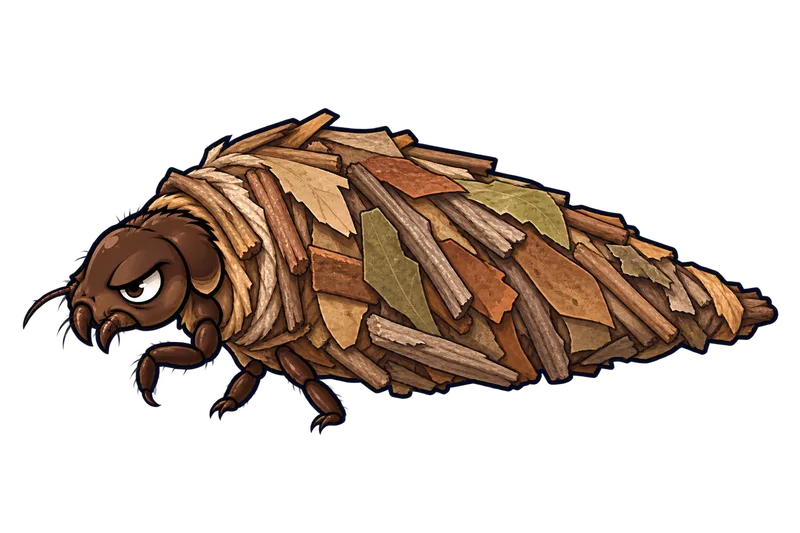
Plaster bagworms are case-bearing caterpillars that spend their larval stage inside a portable, spindle-shaped silken case. They crawl slowly along interior walls while grazing on microscopic detritus, dust, and spider webs, using fine grit from the wall as building material.
What is actually going on
You are wiping down the baseboards in the hallway, or perhaps staring at the bathroom wall while brushing your teeth, when you notice a tiny gray speck that looks remarkably like a stray grain of rice. You reach out to flick it away, only to realize the speck is crawling. It drags itself along the plaster surface with a curious, methodical deliberation. You are looking at a case-bearing caterpillar, commonly called a plaster bagworm or household casebearer, making its slow journey across your interior walls.
To understand what is actually happening in your home, you have to look past the general insect term and see the biology. The creature spends its larval stage inside a portable, spindle-shaped silken case. It spins this protective envelope using its own silk glands, and then armor-plates the exterior by incorporating bits of ambient environmental debris. As the caterpillar crawls across your walls, it extends its head and front thoracic legs out of one end of the case, anchoring its back end firmly inside the silken lining. It pulls its mobile sleeping bag wherever it goes, grazing on microscopic detritus, spider webs, sloughed skin scales, and dust.
Many homeowners assume that finding these cases means the insects are actively chewing away at the plaster walls. That is a misconception. Plaster contains no nutritional value for them. The larvae are simply using the fine grit of the wall as building material while they hunt for stray organic particles. Once the caterpillar finishes feeding and growing, it attaches its case permanently to a vertical surface, a molding, or a hidden ledge, turning it into a stationary pupa. After a few weeks, an adult moth emerges, leaving behind a papery, empty silken shell stuck to your wall.
How to tell for sure
Spotting tiny gray cases on your plaster walls or baseboards is usually the first reliable clue, but a few specific details help separate them from other household nuisances. The larval case looks like a flattened, pumpkin-seed-shaped pouch or a tiny gray capsule. If you watch one long enough, you will usually see a small, dark head and front legs emerge to pull the structure forward.
People frequently confuse the hard, colored granules found near these cases with moth eggs. Those little specks are actually frass, which is just the ordinary term for larval droppings. True moth eggs are microscopic, soft, and translucent, whereas frass pellets are hard, opaque, and usually match the color of whatever the insect has been eating.
Microhabitat preferences also offer strong identification clues. These insects thrive in undisturbed, humid environments. You will usually find them resting vertically along baseboards, beneath heavy furniture, inside dark closets, or near ceiling-wall junctions, especially if indoor humidity creeps upward.
What usually comes next
When you find a handful of these cases clinging to your walls, your immediate practical decision usually comes down to choosing between a deep cleaning overhaul or chasing quick chemical fixes. Reaching for a can of household bug spray and blanketing your baseboards might feel satisfying, but it misses the root cause entirely. Because these larvae survive by scavenging dust, hair, and microscopic organic debris in neglected zones, spraying chemicals over an uncleaned surface is largely a waste of time.
The most effective step you can take right now is physical removal combined with climate control. Grab a vacuum cleaner equipped with a crevice tool and thoroughly clear out the junctions where your floors meet the walls, the corners of your closets, and the spaces beneath heavy furniture. Getting rid of the accumulated lint and hair starves any remaining larvae of their food source.
At the same time, look at the humidity in your home. These moisture-loving pests struggle to thrive when the air is dry. Keeping your indoor relative humidity below fifty percent using air conditioning or dehumidifiers creates an environment where they simply cannot flourish. Once you handle the physical cleaning and dry out the microhabitats they love, the population usually collapses without a single drop of pesticide.
When to get help
Most minor encounters with case-bearing caterpillars can be managed with routine cleaning and environmental adjustments, but certain situations cross the line into territory requiring outside help. If you notice an overwhelming, persistent infestation that seems to originate deep inside wall voids, floor joints, or your heating and cooling ductwork across multiple rooms, call a licensed pest management professional. They have the equipment and experience to treat hidden reservoirs that standard household cleaning cannot reach.
You should also bring in an expert if the pests are actively damaging high-value, fragile, or historic heirloom textiles, museum artifacts, or specialized taxidermy. These delicate items require specialized treatments rather than standard do-it-yourself methods that might ruin the fabric.
On the health front, it helps to know what these creatures cannot do. Case-bearing moths do not bite, sting, suck blood, or carry infectious diseases. However, the shed larval skins, dry frass dust, and tiny bristly hairs left behind can trigger skin irritation or aggravate asthma and allergies in sensitive individuals. If anyone in your household develops unexplained skin lesions, persistent rashes, severe allergic reactions, or respiratory distress, do not try to diagnose the issue yourself. Consult a licensed clinician, an urgent care center, or your local poison control center immediately.