
What do mole crickets eat?
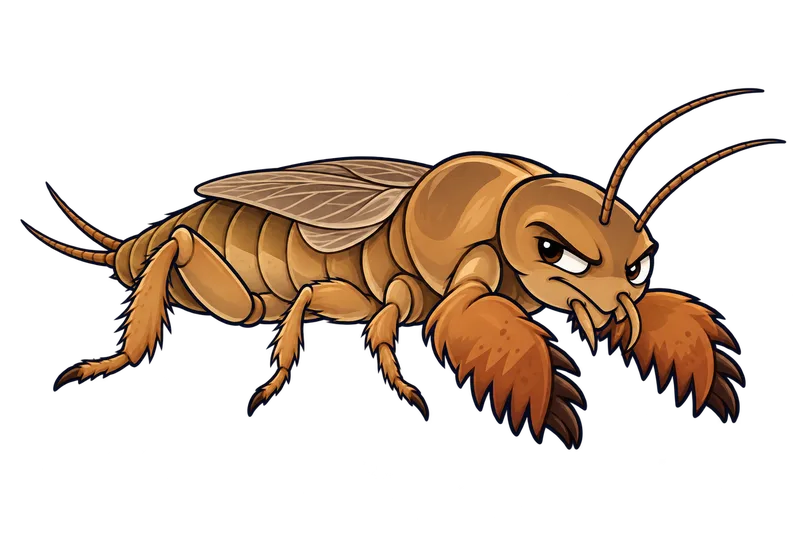
What mole crickets eat depends entirely on the specific species in your yard. The tawny mole cricket is a strict vegetarian that eats grass roots, stems, leaves, tubers, and garden vegetables. The southern mole cricket is a predator that mostly hunts earthworms and soil insects.
What is actually going on
Picture a Saturday morning, coffee in hand, and you notice a strip of lawn that looks like someone dragged a garden fork through it overnight. Raised, squiggly little ridges of dirt snake across the thin spots, and when you step on the area, the ground gives under your shoe like a foam mattress instead of solid turf. Something down there is very busy, and the obvious question is: busy eating what?
The honest answer is that it depends on which mole cricket you have, because these insects are not all working from the same menu. The tawny mole cricket, the worst lawn pest of the bunch in the Southeast, is a strict vegetarian. It eats living plant tissue: grass roots, stolons (those horizontal runners that grasses like bermuda use to spread), tubers, tender stems, and leaves. It is especially fond of bahiagrass and bermudagrass, which is bad luck if that is what your lawn is made of, and it is not picky beyond turf either. Vegetable gardeners lose potatoes, tomatoes, peppers, carrots, beets, strawberries, and peanuts to it. A seedling is sometimes sheared off at the soil line and dragged down into the burrow like groceries.
The southern mole cricket, which looks almost identical and gets blamed for the same damage, is mostly a meat eater. It hunts earthworms, insect larvae, and other small creatures living in the soil. It can nibble plant material, but barely does. The catch is that it still wrecks lawns, just not by eating them. Those broad, spade-like front legs churn through the top 10 inches of soil, severing roots and loosening everything so the grass dries out and dies even when you water faithfully. So the tunnels you see are not necessarily a feeding frenzy. Sometimes they are just the commute.
One more wrinkle explains why damage seems to explode in late summer. Newly hatched nymphs, barely a quarter inch long, start life underground in a chamber, where they eat their own egg shells and, charmingly, sometimes weaker siblings. Then they come up and feed near the surface, and they keep eating and growing through the warm months. Small crickets, small damage. By August, big crickets, big appetite, big brown patches.
How to tell for sure
Since the diet and the fix both depend on the species, you need to know what you actually have, and here is the good news: you can check this at your kitchen table. Catch one (they come up at night, and the flying ones are drawn to porch lights), flip it over, and look at the front legs. Count the claws, technically called dactyls, on those digging legs. The invasive pest species, tawny, southern, and shortwinged mole crickets, have exactly 2 prominent blade-like claws on each foreleg. The native northern mole cricket has 4. A 10x hand lens makes this easy, but decent eyesight and a phone flashlight usually do the job.
That claw count matters more than it seems. The native 4-clawed mole cricket is an omnivore that eats a bit of everything, roots and soil critters alike, and it almost never builds up enough numbers to hurt a lawn. Treating for it is wasted effort and wasted chemical. The 2-clawed crowd is where the trouble lives.
You cannot tell tawny from southern by diet from your porch, but you can read the damage. If grass is being eaten down, seedlings are vanishing, and the turf is thinning from actual chewing, a plant eater is usually at work. If the grass looks mostly intact but the ground is spongy, ridged, and collapsing, tunneling is the main problem, which points toward the predatory southern species or simply heavy activity from any of them. Neither diagnosis is perfect from damage alone, so the claw check on a captured cricket beats guessing.
And if your lawn feels soft underfoot, do not automatically blame mole crickets. White grubs cause a similar sponginess, but they eat roots in a tidy horizontal layer, so the dead turf peels back like a carpet with no surface ridges. Mole crickets leave those raised, winding dirt veins and churned soil that collapses when you step on it. Geography narrows it further. Pest mole crickets live in the warm, sandy soils of the Southeast, roughly the coastal plain from North Carolina to Texas, plus Florida. A spongy bluegrass or fescue lawn in Ohio is grubs, webworms, or earthworms, not mole crickets.
Before you treat anything, run the soap flush, which is basically a 3-minute lie detector test for your lawn. Mix 1.5 tablespoons of liquid dish soap into 1 gallon of water and pour it evenly over a 2 foot by 2 foot patch of moist, suspicious turf in the morning. Wait 3 minutes and count what surfaces. Two to four crickets in that square is the usual threshold where treatment starts to make sense. One lonely cricket is just a cricket.
What usually comes next
The most useful decision you can make is about timing, and this is where people love to aim at the wrong thing. Those big, loud adults banging around the floodlights in spring look guilty as sin, and spraying them feels productive. Mostly it is theater. They have already mated and laid eggs, they are near the end of their run anyway, and their thick bodies and deep burrows shrug off a lot of what gets thrown at them. Chasing spring adults is like chasing the delivery truck after the packages are already sitting on porches.
The real target is the next generation: the tiny quarter-inch nymphs that hatch in early summer, usually late June into July across much of the Southeast. They feed near the surface, they are small, and they have not had all season to turn into armored little bulldozers. That is when treatments, chemical or biological, have their best shot. By late summer they are bigger, deeper, and much less cooperative. In southern Florida there are 2 generations a year, so the window shifts, which is one more reason local extension advice beats a generic calendar taped to the garage wall.
Whatever product route you take, the label is the law and the instructions, not a friendly suggestion. One water rule trips people up constantly: liquid and granular contact insecticides generally need to be watered in lightly afterward to carry the active ingredient into the root zone, and the soil should be moist beforehand so the crickets are up near the surface. Insecticidal baits are the opposite. Never water right after a bait, because moisture ruins it. Same pest, opposite homework. Read the label for your specific product and follow it exactly.
If you would rather lean on biology, there are legitimate options. Beneficial nematodes applied to moist soil in the evening can parasitize mole crickets, and in Florida a parasitic wasp called Larra bicolor hunts them, which you can encourage by planting its nectar sources near turf edges. One caution there: partridge pea, one of the recommended nectar plants, is toxic to grazing livestock, so keep it far from anywhere cattle or horses eat. Meanwhile, the boring habits still pull weight: deep, infrequent watering instead of daily sprinkles, sensible mowing heights for your grass type, and switching off or swapping out bright white outdoor lights during the spring flight season, since the adults home in on them.
When to get help
Call in a licensed turf or pest professional when the infestation covers a large area, when your soap flush counts are well above threshold and climbing, or when you have already treated once correctly and the damage keeps spreading. It is also the right call if the effective products for your situation turn out to be restricted-use pesticides, because those can only be bought and applied by a state-licensed applicator, period. Golf courses, sports fields, and pastures with livestock fall into professional territory almost by default, since the tolerance for damage there is basically zero and the stakes are higher than curb appeal.
Get help identifying too, if you are torn between mole crickets and something else. Your county extension office can confirm the species from a specimen or good photos, and that one step prevents the classic mistake of spending a summer treating the wrong insect with great confidence and poor results.
Two safety notes deserve plain language. First, if raccoons, armadillos, or skunks are tearing up the lawn at night, they are often doing more visible damage than the crickets themselves while digging for them, and wildlife removal has its own rules. Second, anything involving pesticide exposure, a splash in the eyes, a child or pet getting into a product, is not a wait-and-see situation. Contact Poison Control or a medical professional right away rather than guessing.
The short version to hold onto: figure out which cricket you have, count what the soap flush brings up, aim any treatment at the small summer nymphs rather than the noisy spring adults, and follow the label like it was written for your lawn, because it was.