
What states have kissing bugs?
Short answer
Kissing bugs have been officially documented in 29 United States states. Their geographic reach covers a surprisingly wide swath of the country, but population density and variety change drastically depending on where you live. Texas, New Mexico, and Arizona serve as the primary hot spots, boasting the highest species diversity and the most frequent sightings.
What is actually going on
- You are sitting on your porch on a warm summer evening in Texas, reading your phone by the soft glow of the outdoor light, when a large, unfamiliar bug thuds against the siding and drops onto the deck. You lean in for a closer look, notice its distinct shape, and suddenly remember reading about kissing bugs. Naturally, you start wondering just how far these insects roam and whether you need to check every room in the house.
- The short answer is that kissing bugs have been officially documented in 29 United States states. They are not some exotic pest confined entirely to the tropics, nor are they a brand-new arrival. They have been native to North America since the mid-1800s. While their geographic reach covers a surprisingly wide swath of the country, their population density and variety change drastically depending on where you happen to live.
- If you live in the southern half of the United States, your chances of running into one are significantly higher. Texas, New Mexico, and Arizona serve as the primary hot spots, boasting the highest species diversity and the most frequent sightings. Texas alone hosts 7 distinct native species. Meanwhile, states along the Atlantic coast, the South-Central region, and parts of the Midwest and Mid-Atlantic have occasional historical records, but sightings there remain quite rare.
- It helps to know that finding a kissing bug on your property does not mean an infestation is underway or that danger is guaranteed. These insects live outdoors in brush, rock piles, and rodent nests, and adults only wander indoors because bright porch lights draw them in during the warmer months between May and October.
How to tell for sure
- Before you panic over a visitor on your baseboard, you need to verify what you are looking at, because many harmless insects look remarkably similar. A kissing bug usually measures between 0.5 to 1.25 inches (12 to 32 mm) long, making it roughly the size of a United States quarter.
- Look closely at the head and mouthparts. A kissing bug usually features a distinct, pencil-shaped head that tapers toward the tip, equipped with a long, thin, needle-like beak held flat and straight under its chin. Its legs are uniformly thin all the way down, lacking any swollen or leaf-like segments. The body is typically dark brown or black, usually edged with striking orange, red, or light brown stripes along the exposed outer border of the abdomen.
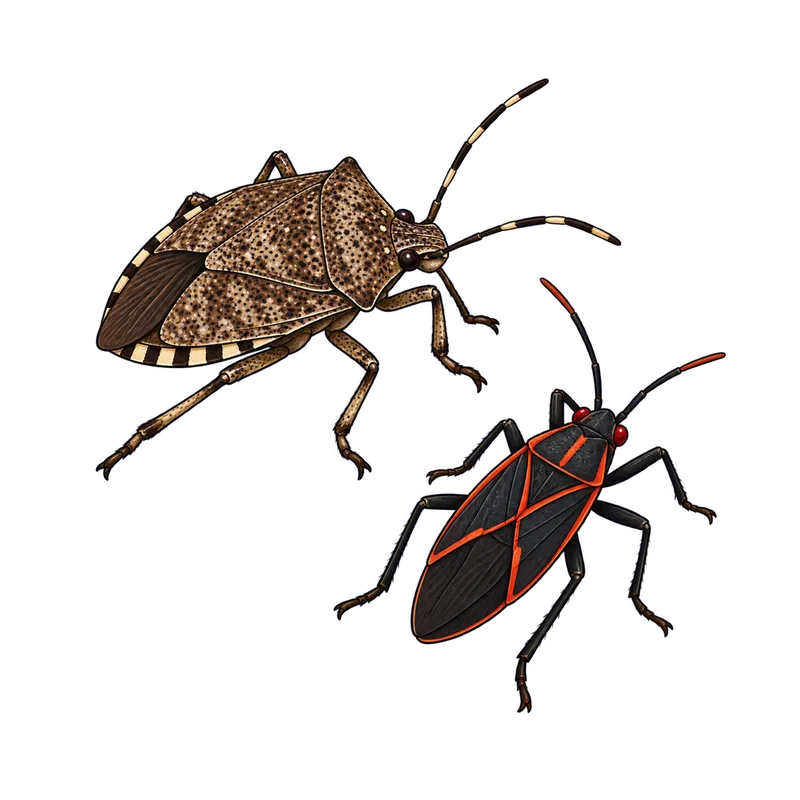
- People frequently confuse them with harmless plant-feeding insects like leaf-footed bugs or squash bugs, which often feature widened, leaf-like hind legs. You might also mistake them for predatory assassin bugs or wheel bugs. Those predators possess short, thick, curved beaks and deliver an immediate, intensely painful jab if you disturb them. Kissing bugs, by contrast, have straight mouthparts and deliver a painless bite if they feed at all.
- You should also keep in mind that nymph, or immature, kissing bugs are wingless and cannot fly. Adults, however, possess fully functional wings and are capable of flight. If you find a tiny bug that looks like a miniature version of an adult, it is usually a nymph that crawled in through a ground-level gap rather than flying through an open window.
What usually comes next
- When you spot a suspected kissing bug inside your home, your most practical immediate decision is to capture it safely without crushing it. Never touch one with your bare hands, and resist the temptation to squish it with a shoe. Crushing the insect can release internal body fluids and feces, which is where the real health risks reside.
- Instead, put on a pair of disposable gloves or use the classic inverted plastic bag method. Slip your hand inside a sealable plastic bag like a glove, pick up the bug gently through the plastic, and then flip the bag right-side out while sealing it shut. If you prefer to use a rigid container with a tight lid, gently guide the insect inside using a piece of cardboard.
- Once the bug is safely contained, place the sealed bag or container into your freezer for several hours. This humanely kills the insect while keeping its physical structure and DNA intact should you decide to submit it to a state health agency or university extension program for identification. After securing the bug, clean the surface where you found it using a fresh mixture of household bleach and water.
- Beyond managing the individual insect, your next steps usually involve basic exclusion work. Seal up gaps around your doors and windows, repair torn screens, and switch your bright white outdoor porch bulbs to warm yellow bug lights that fail to attract nocturnal insects.
When to get help
- There are moments when a casual pest sighting crosses the line into a situation that requires medical or professional intervention. If you or a family member gets bitten by a kissing bug and experiences symptoms of a severe allergic reaction, such as difficulty breathing, throat tightness, widespread hives, dizziness, or rapid facial swelling, treat it as a medical emergency and call 911 immediately.
- If you find a kissing bug on your skin or suspect you were bitten while sleeping, and you begin noticing unexplained eyelid swelling or localized skin lesions, consult a clinician or an infectious disease specialist. Healthcare providers rely on specific blood tests to evaluate whether a parasite transmission occurred, particularly in regions where Chagas disease is a reportable condition.
- For definitive species identification or to report a confirmed specimen, reach out to your local vector control district or state health department. State agencies often maintain dedicated citizen science programs or submission protocols to track triatomine populations. If you suspect an established outdoor habitat or a heavy indoor presence around your property, leave large-scale chemical treatments to a licensed pest control professional who operates under state structural regulations.