
Why are false chinch bugs common in Tucson?
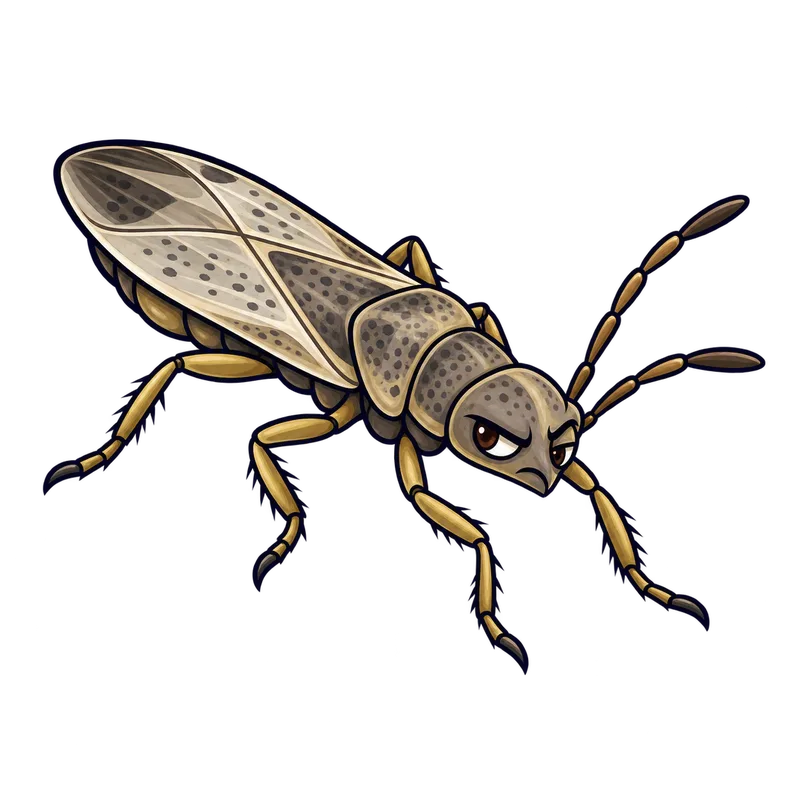
False chinch bugs are common in Tucson because the local desert grows them in large numbers during wet, mild winters. When the heat arrives between April and June, wild mustards dry up and millions of these native insects migrate toward irrigated yards in search of food and moisture.
What is actually going on
Picture a May morning in Tucson. You step onto the patio with coffee and stop, because the dark gravel you noticed yesterday is moving. What looked like spilled coffee grounds turns out to be thousands of tiny insects crawling in one direction, across the concrete, up the wall, toward anything green. You have just met the false chinch bug, Nysius raphanus, and your yard is one stop on a very large commute.
The short answer to why they are so common in Tucson is that the desert itself grows them. False chinch bugs are native to the Southwest and spend the cooler months out in the open desert, feeding on wild plants. When Tucson gets a wet, mild winter, that moisture triggers dense stands of winter weeds, especially wild mustards, across uncultivated ground and foothills. Those weeds are a false chinch bug buffet. Females lay eggs in loose soil around the plants, the nymphs hatch and suck sap from the mustard, and a new generation matures in roughly three weeks. Cool spring weather keeps the weeds alive long enough for several generations back to back, so the population does not just grow. It explodes.
Then comes the part Tucson does best: the heat arrives fast. By late spring, usually sometime between April and June, the wild mustards dry out and die within days. Millions of bugs suddenly have no food and no moisture, so they do the sensible thing and head for the nearest green, watered place. That place is your irrigated lawn, your garden, and the shaded side of your house. The swarms look dramatic, but the whole invasion typically runs its course in one to three weeks before the bugs disperse or die off.
Here is the part that matters most: they are harmless to you. False chinch bugs feed with a straw-like beak built for piercing plant tissue and sipping sap. They cannot bite people or pets, they do not sting, and they do not transmit disease. They are not ticks, not fleas, and they do not infest your house, your furniture or your pantry. They are lost desert vegetarians passing through your zip code.
How to tell for sure
The bugs causing this are usually easy to recognize once you know what to look for. Adults are small, about 1/8 to 1/6 inch long, dull grayish-brown with a slightly yellow tint. The head is broad, nearly as wide as the body segment behind it, and the wing tips are clear, without a dark triangular spot on the outer edge. The nymphs are the ones that create the moving coffee grounds effect: gray-brown, mottled, with small orange flecks on the abdomen, no wings, and they travel in dense crowds along the ground.
The identification that actually matters is the one that keeps you from panicking about your lawn. True chinch bugs, the Blissus species famous for killing turf, look similar at a glance but behave very differently. True chinch bug adults are black with white wings and carry a distinct black triangular patch on the wing margin, and their young nymphs are bright red with a white band across the body. False chinch bug nymphs are never bright red and never have that white band. If you want certainty, a 10x hand lens is enough to check the wing markings on an adult. Still not sure? The University of Arizona Cooperative Extension can confirm a specimen for you, which beats guessing.
One more distinction worth making: if you find an eight-legged creature attached to skin, that is not a false chinch bug, full stop. These are six-legged, winged insects, and they do not attach to anything with a pulse. Never try to identify any pest from a bite or a mark on skin, because skin reactions cannot reliably tell you what caused them.
What usually comes next
The practical decision most Tucson homeowners face is simple: do I spray, or do I wait? For established yards, waiting combined with a little housekeeping is usually the right call, and here is why. Spraying outdoors tends to be a losing game, because new bugs keep marching in from the surrounding desert faster than any treatment can stop them. You would essentially be defending a doorway in a flood.
The sensible sequence looks like this. Keep doors, sliding doors and windows shut during the migration weeks, and check weatherstripping and screens for gaps. Vacuum up any stragglers that get inside, then empty the canister or bag into an outdoor trash bin right away, because these bugs release an unpleasant stinkbug-like odor when crushed. Whatever you do, resist the urge to squish them on the kitchen tile unless you enjoy seasoning your floor with eau de stinkbug. Outdoors, a strong stream of water from the garden hose knocks aggregations off walls, walkways and patio furniture, and keeping your plants well watered during those weeks helps them shrug off the sap loss. If you have young vegetable seedlings near open desert, a floating row cover over the beds until the wave passes is cheap insurance.
The one situation where waiting is a bad idea involves young plants. Mature trees, established turf and grown landscape plants usually come through with nothing worse than temporary wilting. But brand-new seedlings and young saplings, things like recently planted citrus, pomegranate, almond or pistachio trees, can be overwhelmed when thousands of bugs pile onto them at once. Heavy feeding can scorch leaves and even kill a young tree, so those are the plants worth covering or washing down daily until the swarm moves on.
When to get help
For a typical home invasion, you do not need anyone. The bugs leave on their own in one to three weeks, your lawn survives, and the whole episode becomes a story you tell the neighbors.
Professional help makes sense in specific situations. If you run a nursery, a greenhouse or a young orchard and swarms are settling on stock you cannot afford to lose, that is a job for a licensed pesticide applicator, who can judge whether treatment is worthwhile and apply anything used exactly according to its label. If bugs are entering a commercial building in huge numbers through HVAC systems or wall voids, a licensed pest control company is the right call. And if you simply cannot pin down what insect you are looking at, the county extension diagnostic service can identify a specimen so you are not treating the wrong problem.
On the health side, if anyone in the household develops a bite-like reaction, a rash or any skin concern during bug season, see a clinician or contact poison control rather than blaming the swarm. False chinch bugs do not bite, so a skin reaction points to something else, and that something else deserves proper medical attention, not guesswork.
So the next time the patio gravel starts moving, you can finish your coffee first. Close the door, keep the hose handy, cover the baby trees, and give it a couple of weeks. The desert grew them, the heat evicted them, and your porch was never really the destination.